

Updated July 2026
A bowling pinsetter price cannot be compared accurately without knowing the equipment type and quotation scope. The price currently publishes an $8,000–$12,000 per-lane FOB planning reference for its commercial string pinsetter systems. Other commercial string models and new free-fall machines are commonly sold through project quotations rather than fixed public price lists.
The final bowling pinsetter cost may also include freight, import duties, removal of existing machinery, pit or electrical modifications, scoring integration, ball-return work, installation, commissioning, staff training, and opening spare parts. Buyers should therefore compare itemized project scope—not only the advertised machine price.
The figures in this guide use Flying Bowling’s published equipment references reviewed in July 2026 together with current official manufacturer and governing-body information. They are planning references, not standardized market averages. Unless a quotation states otherwise, freight, taxes, local installation, scoring integration, building work, and site preparation should be treated as separate costs.
Bowling Pinsetter Cost at a Glance
| Pinsetter option | Public planning reference | What must be confirmed |
|---|---|---|
| Flying Bowling commercial string pinsetter | $8,000–$12,000 per lane, FOB planning reference | Exact model, included controls, scoring interface, warranty, freight, and installation |
| Other new commercial string systems | Manufacturer quotation required | Certification, compatibility, software, installation, and service terms |
| New free-fall pinsetter | Manufacturer quotation required | Machine scope, pit requirements, scoring, freight, specialist labor, and commissioning |
| Used or refurbished pinsetter | Condition-specific quotation | Age, rebuild history, missing parts, remaining service life, and local support |
| Replacement or retrofit project | Equipment price plus project costs | Removal, civil and electrical changes, scoring integration, downtime, and training |
Published pricing varies because one offer may cover only the machine while another includes controls, pins, spare parts, scoring interfaces, installation, or a complete lane package. The first question should always be: What is included in this price?
What Is a Bowling Pinsetter?
A bowling pinsetter detects standing and fallen pins, clears the deck, and prepares the correct rack for the next delivery or frame. The ball-return system is normally a separate but connected component, so buyers should not assume that a pinsetter quotation automatically includes the ball lift, return track, scoring system, pins, or lane construction.
Modern centers generally choose between string pinsetters, where each pin is connected to an overhead lifting mechanism, and free-fall pinsetters, where pins are collected and repositioned through a larger mechanical handling system. The correct choice depends on the venue, competition requirements, existing infrastructure, maintenance capability, and total cost of ownership.
String Pinsetter Cost
Flying Bowling’s published guide currently uses an FOB planning range of $8,000–$12,000 per lane for its commercial string systems. This should be treated as a supplier-specific equipment reference rather than a universal market average.
Final string pinsetter pricing varies by model, approval status, lane count, scoring interface, control system, destination, spare-parts package, warranty, and whether the machine is purchased separately or as part of a complete lane system.
For a deeper breakdown of string-specific pricing, see Flying Bowling’s string pinsetter cost guide. This broader article should remain focused on the total cost of comparing, installing, or replacing all pinsetter types.
Free-Fall Pinsetter Cost
New free-fall pinsetters are usually priced through model-specific commercial quotations. Current official product pages from major manufacturers generally describe equipment features and service scope without publishing a standardized per-lane price.
A free-fall proposal may include a different combination of machine hardware, guarding, controls, scoring integration, installation, training, and warranty. For that reason, a single universal “average price” can be misleading unless the scope and model are clearly identified.
Free-fall systems may remain suitable when an existing center already has compatible pits and service infrastructure, when trained mechanics and replacement parts are available, or when the operator prioritizes traditional free-fall machinery and pin action.
String vs Free-Fall Cost Comparison
| Cost factor | String pinsetter | Free-fall pinsetter |
|---|---|---|
| Public price availability | Some suppliers publish equipment references | Usually quote-based |
| Mechanical structure | Generally fewer major pin-handling assemblies | More mechanical pin transport and setting assemblies |
| Routine service | Model-specific strings, sensors, motors, and controls | Model-specific belts, motors, handling parts, assemblies, and controls |
| Back-end planning | Often more compact | Often requires a traditional machine area |
| Best-fit decision | New builds, selected retrofits, FECs, and approved league installations | Existing free-fall centers and operators with suitable infrastructure and technical support |
For a more detailed technical comparison, see the string pinsetter vs free-fall guide.
Brand and Model Comparison
| Model | Type | Current public status | Public price |
|---|---|---|---|
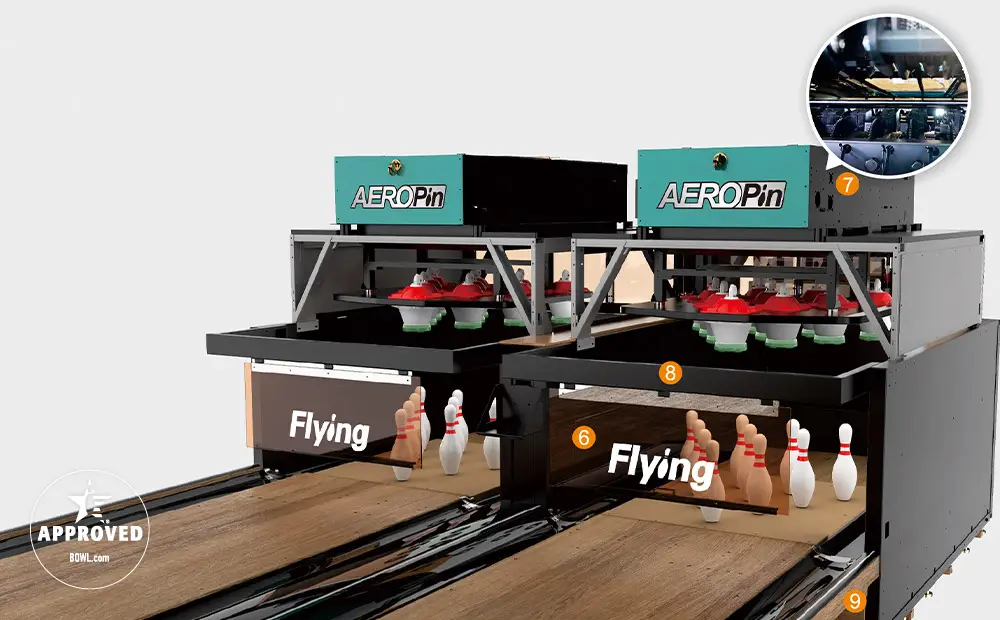
| Flying Bowling AEROPIN | String | Listed by USBC as an approved string pinsetter | Model-specific quote; supplier guide publishes a broader $8,000–$12,000 FOB string reference |
| Brunswick Boost ST | String | USBC-approved commercial model | Quote required |
| Brunswick GS NXT | Free-fall | Current commercial free-fall system with integrated diagnostics | Quote required |
Approval status, machine type, and public product positioning can be compared, but purchase price must still be confirmed through a current itemized quotation. Certification alone does not prove that one model will be more expensive than another.
What Is Included in a Pinsetter Price?
How Much Does It Cost to Replace an Existing Pinsetter?
A replacement budget is the sum of several project costs rather than one standard number:
| Replacement item | Budget treatment |
|---|---|
| New pinsetter | Use the current model-specific equipment quotation |
| Existing machine removal | Quote dismantling, lifting, disposal, and protection of the existing lane separately |
| Pit, floor, guarding, and electrical work | Price after a site survey and comparison with the manufacturer’s civil drawings |
| Scoring and ball-return integration | Confirm whether existing systems can be retained, modified, or replaced |
| Freight, customs, and unloading | Calculate by destination, Incoterm, shipment volume, and local handling requirements |
| Downtime | Estimate lost operating time based on whether work is performed lane by lane or during a full closure |
Without a site survey, it is not responsible to publish one universal replacement price. A useful quotation should separate the new machine from removal, retrofit, freight, integration, commissioning, and downtime assumptions.
New vs Used or Refurbished Pinsetters
Used equipment may reduce the purchase price, but buyers must verify the manufacturing year, operating history, rebuild records, missing components, guarding, control hardware, scoring compatibility, parts availability, technician availability, and transport cost.
New equipment generally provides clearer documentation, current control hardware, and defined warranty terms. Used equipment is more practical when the buyer already operates the same model and has the parts, tools, and technical experience needed to support it.
What Factors Affect Bowling Pinsetter Cost?
Total Cost of Ownership Matters More Than Purchase Price
A lower-priced machine can become expensive if parts are difficult to obtain or downtime is frequent. A higher-priced system can also be poor value if its additional features are unnecessary. Operators should build a cost model using their own lane count, opening hours, local labor rate, technician availability, electricity cost, and parts delivery time rather than relying on generic ROI promises.
Is a USBC-Approved String Pinsetter Necessary?
Not every entertainment venue requires USBC-approved equipment. A social bowling venue, hotel, private residence, or FEC may prioritize layout, ease of operation, and service support. A center planning USBC-certified league or tournament play should confirm that the exact model appears on the current official list and that the complete installation meets applicable requirements.
The current USBC approved string pinsetter list includes Flying Bowling’s AEROPIN, approved on January 21, 2026. Buyers should recheck the official list before purchase because approvals are model-specific and may be updated.
Questions to Ask Before Buying
- Is the price equipment-only, FOB, landed, or fully installed?
- What exact model and configuration are included?
- Does the intended use require an approved competition model?
- Are scoring and ball-return interfaces included?
- What civil and electrical work is excluded?
- Who removes the existing machinery and handles disposal?
- What spare parts should be stocked before opening?
- Which maintenance tasks can venue staff perform?
- What does the warranty cover and exclude?
- How quickly can replacement parts reach the destination?
- Who performs installation, commissioning, and training?
- What documentation is supplied for final acceptance?
Flying Bowling Pinsetter Options
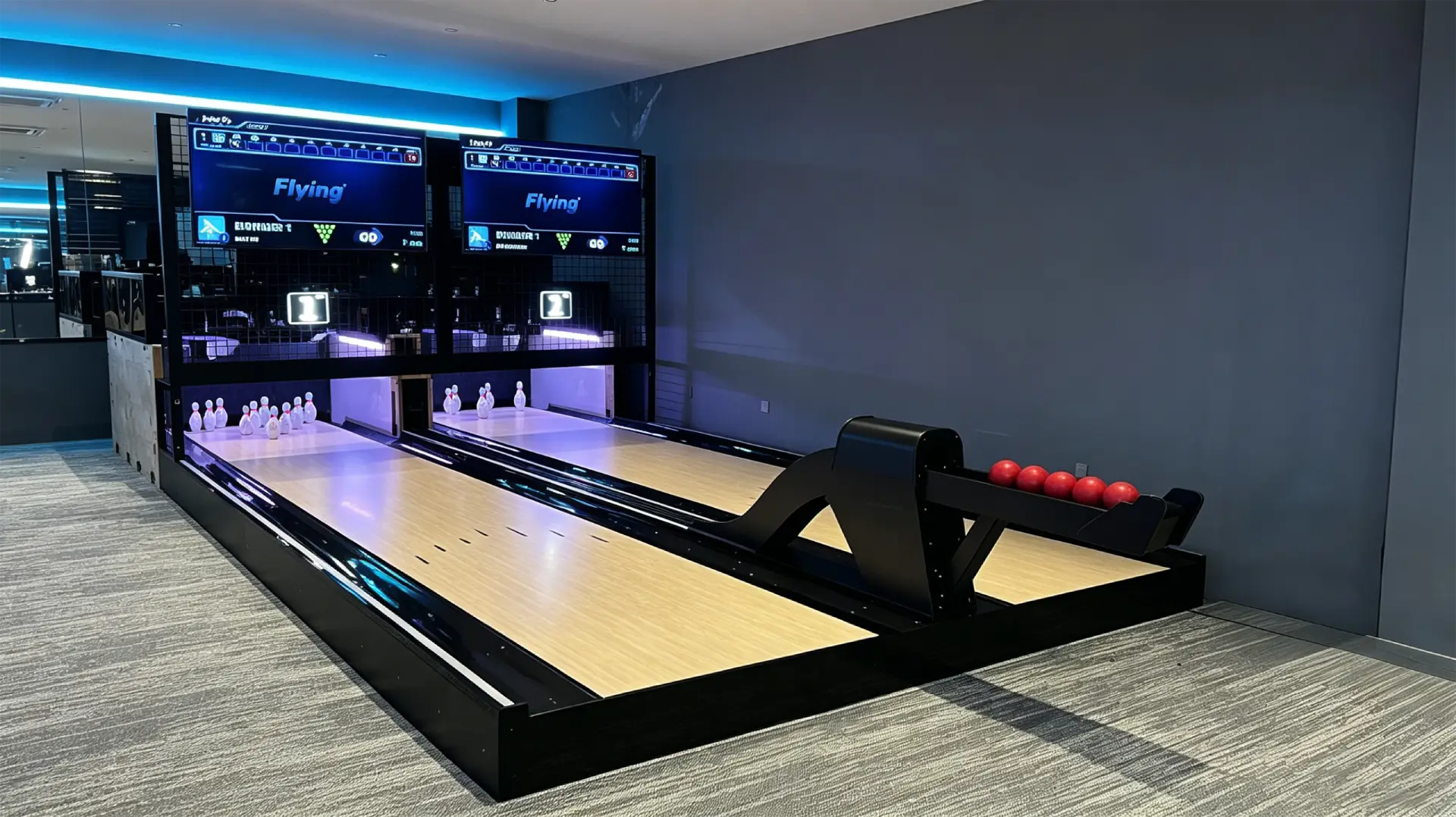
Flying Bowling supplies the AEROPIN USBC-certified string pinsetter and can integrate it into a complete string pinsetter bowling lane system with lane components, scoring, ball return, pins, controls, and project-specific installation planning.
The final scope depends on lane count, regulation or entertainment use, room dimensions, scoring requirements, destination, installation responsibility, and target opening date. Warranty, delivery time, included components, and after-sales support should be confirmed in the itemized quotation.
Final Recommendation
A realistic bowling pinsetter budget begins with the exact machine and ends with the complete project scope. Flying Bowling publishes an $8,000–$12,000 FOB reference for its commercial string systems, while other string and free-fall models should be compared through current quotations with matching inclusions.
Do not choose a pinsetter from the headline price alone. Compare approval status, scoring compatibility, site modifications, freight, installation, spare-parts support, staff capability, and expected downtime.
Request an Itemized Bowling Pinsetter Quote
Share your project country, lane count, room dimensions, existing equipment, intended bowling format, and target opening date. Request separate figures for equipment, freight, removal, installation, scoring integration, commissioning, and spare parts.
Request a Pinsetter Quotation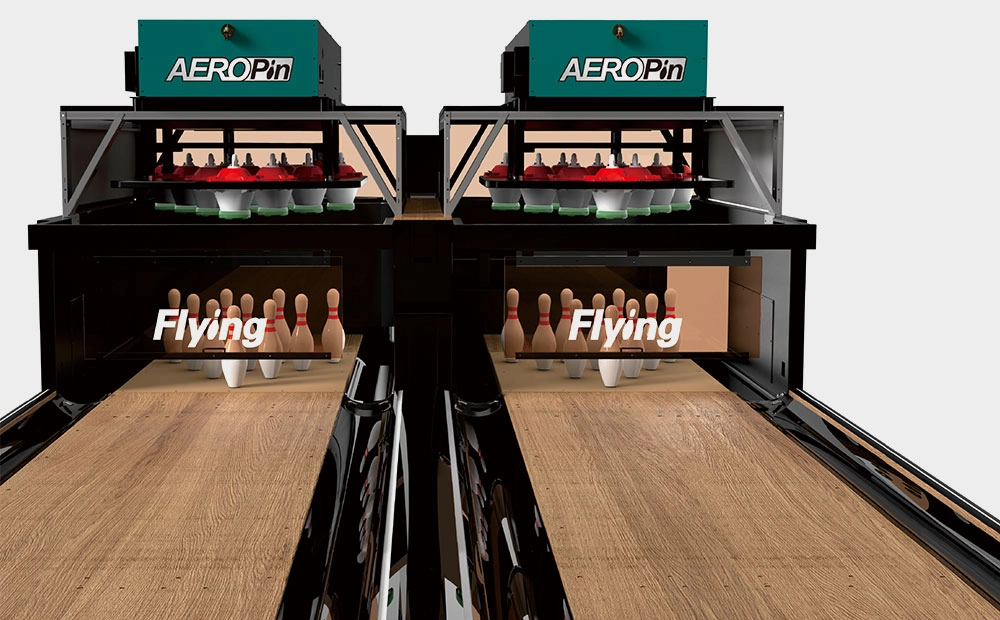

Flying Bowling
Flying Bowling
Flyingbowling
Flyingbowling
Flyingbowling