

Bowling Alley Investment Guide: How to Evaluate Cost, ROI and Project Risk
- 1. Start With Total Project Capital, Not Equipment Price
- 2. Build the Full Investment Budget Before Calculating ROI
- 3. Evaluate Bowling Equipment by Total Cost of Ownership
- 4. Build the Bowling Equipment Profit Model From Separate Revenue Streams
- 5. Use Revenue per Lane to Test the Core Bowling Asset
- 6. Build OPEX From Actual Cost Categories
- 7. Calculate ROI Only After the Inputs Are Verified
- 8. Stress-Test the Investment With Three Scenarios
- 9. Model Seasonality Instead of Multiplying One Month by Twelve
- 10. Validate Market Demand Before Finalizing the Project
- 11. Separate Bowling Equipment From Technology Investment
- 12. Financing Must Be Modeled by Country and Borrower
- 13. Evaluate Franchise vs Independent as an Investment Decision
- 14. Treat Risk as Part of the Financial Model
- 15. Make the Business Plan Match the Financial Model
- 16. Investor Due-Diligence Checklist
- 17. Common Bowling Investment Mistakes
- 18. Long-Term Value and Exit Planning
- Conclusion
- Planning a Bowling Investment?
- FAQ
A bowling alley investment should be judged on total capital required, operating costs, realistic revenue, equipment lifecycle cost, financing, and downside risk. Build the model from actual supplier quotations, construction estimates, rent, local wages, utilities, and market-specific utilization—not from a universal cost per lane or fixed payback period.
Revenue should also be modeled by stream. Lucky Strike Entertainment reported FY2025 revenue of US$1.201 billion, with approximately 46% from bowling, 35% from food and beverage, and 19% from amusement and other revenue. This is one large operator's revenue mix, not an industry average, but it shows why investors should model bowling, F&B, events and other revenue separately. Source: U.S. SEC filing
1. Start With Total Project Capital, Not Equipment Price
The first investment question should be:
How much capital does this specific project require before it can operate sustainably?
Equipment price is only one part of the answer. A useful bowling investment model separates the project into three financial layers.
| Financial Layer | Project Inputs |
|---|---|
| CAPEX | Bowling equipment, construction, fit-out, scoring and technology, freight, installation, professional fees and other fixed project costs. |
| OPEX | Payroll, occupancy, utilities, maintenance, software, insurance, marketing and routine operating expenses. |
| Working Capital | Cash needed to support operations during the opening and ramp-up period. |
The numbers should come from actual project evidence. Bowling equipment should be based on supplier quotations, construction on contractor estimates, occupancy on actual lease or property terms, and payroll on local staffing and wage assumptions. This is why a global investment guide should not claim that every bowling alley has the same total startup cost.
2. Build the Full Investment Budget Before Calculating ROI
ROI calculations become misleading when the investment base is incomplete. A budget that includes lanes and pinsetting equipment but leaves out freight, installation, building work, technology, professional fees, permits or working capital can make a project look more attractive than it really is.
Before calculating returns, the investor should know how much cash is required before opening, what recurring operating costs the venue will carry, and how much liquidity may be needed if utilization develops more slowly than planned.
That last point is particularly important because a completed venue can still consume cash during its opening ramp-up period.
3. Evaluate Bowling Equipment by Total Cost of Ownership
Investors should compare bowling equipment using total cost of ownership, not purchase price alone.
Purchase Price + Freight + Installation + Energy + Maintenance + Replacement Parts + Labor Requirement + Downtime Cost + Future Refurbishment or Replacement
Equipment downtime can have two financial effects. The first is the maintenance or repair cost. The second is the revenue that may be lost when a lane cannot be sold during operating hours.
For this reason, claims such as “X% lower maintenance,” “Y% higher ROI,” or “Z-year payback” should only be used when they are supported by the actual equipment configuration and verified operating data.
4. Build the Bowling Equipment Profit Model From Separate Revenue Streams
A bowling investment model should not treat all revenue as one number. Public-company reporting provides a useful real-world example of how revenue can be distributed across several categories.
| Lucky Strike FY2025 Revenue Stream | Revenue | Approx. Share |
|---|---|---|
| Bowling | US$549.9M | 46% |
| Food & Beverage | US$424.2M | 35% |
| Amusement & Other | US$227.2M | 19% |
| Total | US$1.201B | 100% |
These percentages should not be copied into a new bowling project forecast. Lucky Strike is a large multi-location operator. The useful conclusion is narrower: bowling revenue and secondary revenue should be modeled separately.
The U.S. Census product classification for NAICS 713950 follows a similar logic by distinguishing bowling-center services from party or event packages and separately sold meals and beverages. Source: U.S. Census Bureau
For an investment model, total venue revenue can therefore be separated into bowling revenue + F&B + events + amusement + other applicable revenue. Only include revenue streams that the actual venue concept can support.
5. Use Revenue per Lane to Test the Core Bowling Asset
Total venue revenue alone does not show how effectively the lane assets are being used.
Available Lane Hours × Utilization × Realized Bowling Revenue per Occupied Lane-Hour
Secondary spending should then be modeled separately. Revenue per lane can be affected by opening hours, price, demand, group business, customer mix, lane availability and downtime.
Equipment reliability can influence available selling time, but equipment alone does not determine revenue per lane. A more accurate investor question is: How does the selected equipment configuration affect sellable lane availability, operating cost and lifecycle economics?
6. Build OPEX From Actual Cost Categories
Operating cost should not be hidden inside one generic percentage.
Lucky Strike reported FY2025 US$375.6 million in location operating costs excluding depreciation and amortization, US$284.1 million in location payroll and benefit costs, and US$94.6 million in location food and beverage costs. These figures are company-specific and should not be treated as bowling-industry averages. Source: U.S. SEC filing
What the data does show is that payroll and location-level operating expenses can be financially material. For a new bowling investment, OPEX should be built from the actual venue.
| Cost Category | Best Input |
|---|---|
| Payroll | Required roles × staffing hours × local wage and benefit cost |
| Occupancy | Actual rent, lease or ownership cost |
| Utilities | Local tariffs and expected consumption |
| Maintenance | Selected equipment and service plan |
| Software | Actual system subscriptions and support costs |
| Insurance | Local insurer quotation |
| Marketing | Actual launch and ongoing budget |
| F&B Cost | Menu and supplier assumptions where applicable |
7. Calculate ROI Only After the Inputs Are Verified
The formulas themselves are simple. The difficult part is validating the assumptions behind them.
ROI = Annual Investment Return ÷ Total Invested Capital × 100
Payback Period = Total Invested Capital ÷ Annual Project Cash Flow
| Input | Evidence Required |
|---|---|
| Total Invested Capital | Supplier and contractor quotations |
| Utilization | Market and demand assumptions |
| Bowling Pricing | Local target-market pricing |
| Secondary Spend | Venue-specific F&B and event assumptions |
| Payroll | Staffing plan and local wage rates |
| Occupancy | Actual property or lease terms |
| Maintenance | Selected equipment and maintenance scope |
| Financing | Actual lender terms |
There is no defensible universal claim that every bowling center should pay back in three, five or seven years. The result must come from the individual project model.
8. Stress-Test the Investment With Three Scenarios
One forecast is not enough. A more useful investment model compares conservative, base and upside cases.
| Variable | Conservative | Base | Upside |
|---|---|---|---|
| Lane Utilization | Lower | Expected | Higher |
| Realized Price | Lower | Expected | Higher |
| Secondary Revenue | Limited | Expected | Strong |
| Payroll Pressure | Higher | Expected | Controlled |
| Downtime | Higher | Expected | Lower |
| CAPEX Overrun | Greater | Planned Allowance | Limited |
| Opening Ramp-Up | Slower | Expected | Faster |
Do not populate these cases with generic internet percentages. Use actual market and project inputs. The key decision question is whether the project still has sufficient liquidity and acceptable economics if demand is weaker or costs are higher than expected.
9. Model Seasonality Instead of Multiplying One Month by Twelve
Demand may change through the year. Lucky Strike states in its SEC filing that operating results are seasonal and that factors such as school calendars, holidays and weather can affect sales volumes across markets. Source: U.S. SEC filing
This does not establish one universal bowling season. It supports a better modeling method: use monthly or quarterly assumptions when local seasonality is material. A tourism venue, suburban family-entertainment center and league-oriented bowling venue can have very different demand patterns.
10. Validate Market Demand Before Finalizing the Project
A financial model should not be created after the investor has already committed to a lane count and then adjusted until the numbers appear attractive. Market feasibility should come first.
The investor needs evidence for target customers, catchment and local demand, competing entertainment, pricing, venue concept, expected utilization, group and event potential, and location suitability.
These findings then influence the physical and financial project. If the revenue model assumes strong event business, the venue should have the space and operating capability to support events. If it assumes high utilization, the market evidence should support that assumption.
11. Separate Bowling Equipment From Technology Investment
A bowling project can require technology investment beyond the core lane and pinsetting systems. Depending on the project, this may include scoring, displays, reservation systems, POS, payment systems, network infrastructure and audiovisual systems.
Some of those expenses are CAPEX, while others may create recurring OPEX through subscriptions, support, connectivity or future upgrades. The investment model should therefore separate Bowling Equipment CAPEX from Technology CAPEX / OPEX where appropriate.
12. Financing Must Be Modeled by Country and Borrower
Financing structures vary substantially by country.
For qualifying U.S. businesses, the U.S. Small Business Administration states that its 7(a) program has a maximum loan amount of US$5 million and can support eligible uses including real estate, working capital and machinery or equipment installation.
The SBA 504 program provides long-term financing for qualifying major fixed assets, with a maximum loan amount of US$5.5 million.
A policy effective July 4, 2026 allows eligible borrowers to combine 7(a) and 504 financing for up to US$10 million in cumulative SBA-backed financing. These figures apply to SBA programs in the United States and are not global bowling-investment financing standards.
Projects in other countries should be modeled using the actual locally available debt, equipment finance, property finance or equity structure. Investors should also keep project economics separate from financing economics. Favorable financing cannot repair a weak operating model.
13. Evaluate Franchise vs Independent as an Investment Decision
The franchise-versus-independent decision should be evaluated financially rather than reduced to “brand versus freedom.”
| Factor | Investment Question |
|---|---|
| Initial Fees | What additional upfront capital is required? |
| Recurring Fees | What effect do they have on cash flow? |
| Brand | Is there evidence it improves demand in this market? |
| Supplier Restrictions | Do they affect purchasing flexibility? |
| Operating Support | What is actually included? |
| Control | How much flexibility remains over pricing and concept? |
Generic franchise fees or royalty percentages should not be published unless they come from a verified agreement for the specific brand.
14. Treat Risk as Part of the Financial Model
Risk should change the numbers, not sit in a generic paragraph at the end of an investment guide.
Important downside variables may include lower utilization, construction overruns, delayed opening, higher labor cost, higher occupancy cost, downtime, weak secondary revenue, financing pressure and insufficient working capital.
Lucky Strike's public filings identify factors including seasonality, labor availability and costs, and lease obligations as risks that can affect its own operating performance. Source: U.S. SEC filing
For a new bowling investment, the more useful exercise is to test what happens to cash flow if two or three assumptions deteriorate at the same time—for example, lower utilization + higher payroll + delayed opening.
15. Make the Business Plan Match the Financial Model
A business plan is useful only when the commercial story and the financial model describe the same venue.
| Area | What Must Be Defined |
|---|---|
| Market | Demand and target customer evidence |
| Concept | Venue and revenue model |
| Site | Property and occupancy assumptions |
| Capital | Full CAPEX requirement |
| Operations | Staffing and operating structure |
| Revenue | Pricing, utilization and secondary spend |
| Equipment | Lifecycle and maintenance assumptions |
| Financing | Debt and equity structure |
| Risk | Downside cases |
| Cash Flow | Ramp-up and liquidity needs |
| Exit | Long-term ownership strategy |
If the plan assumes strong event revenue but the venue has no suitable group capacity, the model is inconsistent. If it assumes very low payroll but requires high-touch hospitality service, the model is also inconsistent. The investment model should expose these contradictions before money is committed.
16. Investor Due-Diligence Checklist
Before a final investment decision, obtain evidence for the variables that drive the model. The most important inputs include supplier quotations, contractor estimates, property or lease terms, local wage assumptions, utility tariffs, market pricing, competitor research, financing offers, tax and permit information, and working-capital assumptions.
Due-Diligence Rule: Any number that has not yet been verified should be labeled as an assumption, not as a confirmed project cost.
This distinction is particularly important for international projects because freight, duties, construction costs, wages, financing and selling prices can vary substantially between markets.
17. Common Bowling Investment Mistakes
The most serious mistakes usually come from assumptions rather than from one purchase. A project can be misjudged when investors calculate ROI before the full CAPEX is known, omit working capital, overestimate utilization, treat F&B or events as guaranteed income, assume the same demand every month, underestimate payroll, ignore technology costs, or choose equipment only on purchase price.
A useful test is to identify which assumption has the greatest effect on the investment result and then stress-test that assumption more aggressively.
If a small change makes the project financially unacceptable, that assumption requires stronger evidence before the investment decision is made.
18. Long-Term Value and Exit Planning
The investment horizon should extend beyond opening and initial payback. Bowling venues may eventually require equipment refurbishment, technology upgrades, interior renewal or changes to the operating concept.
Investors should consider whether the site, lease, equipment configuration and technology structure provide enough flexibility for future changes.
Possible long-term outcomes can include continued operation, refurbishment, sale of the business, lease transfer or property-related value depending on the ownership structure. A generic EBITDA multiple should not be applied to every bowling project. Future value depends on actual cash flow, assets, lease obligations, liabilities, market conditions and the transaction structure at the time.
Conclusion
A bowling alley investment should be based on real project costs, realistic utilization and revenue assumptions, full operating expenses, equipment lifecycle economics, financing and downside risk.
Build CAPEX from quotations, OPEX from local operating inputs, and revenue from the actual venue model. Then test conservative, base and upside scenarios before relying on an ROI or payback result.
Public financial data can improve the analysis, but it should be used as a reference—not as a substitute for project-specific due diligence.
Planning a Bowling Investment?
Explore Flying Bowling equipment solutions or discuss your project requirements, equipment configuration, and investment planning with the team.
Explore Bowling Solutions Discuss Your ProjectFAQ
What should be included in a bowling alley investment budget?
A bowling alley investment budget should include CAPEX, OPEX, and working capital. CAPEX may include bowling equipment, construction, fit-out, scoring and technology, freight, installation, and professional fees. OPEX includes payroll, occupancy, utilities, maintenance, software, insurance, and
How do you calculate ROI for a bowling alley investment?
A simple ROI formula is: Annual Investment Return ÷ Total Invested Capital × 100. A simple payback calculation is: Total Invested Capital ÷ Annual Project Cash Flow. The result depends on verified assumptions such as utilization, pricing, payroll, occupancy, maintenance, downtime, and financing.
How should bowling equipment ROI be evaluated?
Bowling equipment ROI should be evaluated using total cost of ownership rather than purchase price alone. Investors should consider purchase price, freight, installation, energy, maintenance, replacement parts, labor requirements, downtime, and future refurbishment or replacement.
What revenue streams should be included in a bowling alley profit model?
A bowling alley profit model may include bowling revenue, food and beverage, events, amusement, and other applicable revenue streams. Each stream should be modeled separately using assumptions that match the actual venue concept rather than copied from another operator.
Why is revenue per lane important in bowling investment analysis?
Revenue per lane helps investors evaluate how effectively the lane assets generate income. A practical model considers available lane hours, utilization, and realized bowling revenue per occupied lane-hour. Pricing, demand, operating hours, group business, lane availability, and downtime can all affect the result.
Should investors use one fixed payback period for bowling alley projects?
No. There is no reliable universal payback period for all bowling projects. Payback depends on total capital, utilization, pricing, operating costs, revenue mix, financing, and local market conditions. Investors should calculate payback from the specific project model.
What should a bowling alley investment business plan include?
The business plan should define market demand, target customers, venue concept, site assumptions, total capital requirements, staffing, pricing, utilization, equipment lifecycle costs, financing, downside risks, cash-flow needs, and long-term ownership or exit strategy.
What data should investors verify before investing in a bowling alley?
Investors should verify supplier quotations, contractor estimates, lease or property terms, local wage costs, utility tariffs, market pricing, competitor conditions, financing offers, taxes, permits, and working-capital requirements. Any number that has not been verified should be treated as an assumption rather than a confirmed project cost.
Recommended products
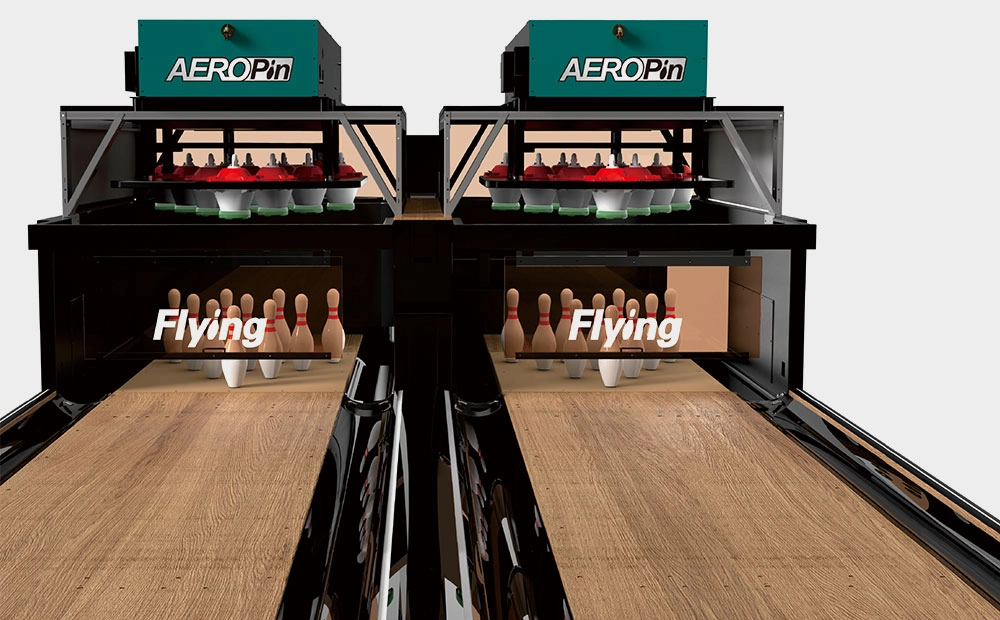
AEROPIN™ USBC-Certified String Pinsetter System
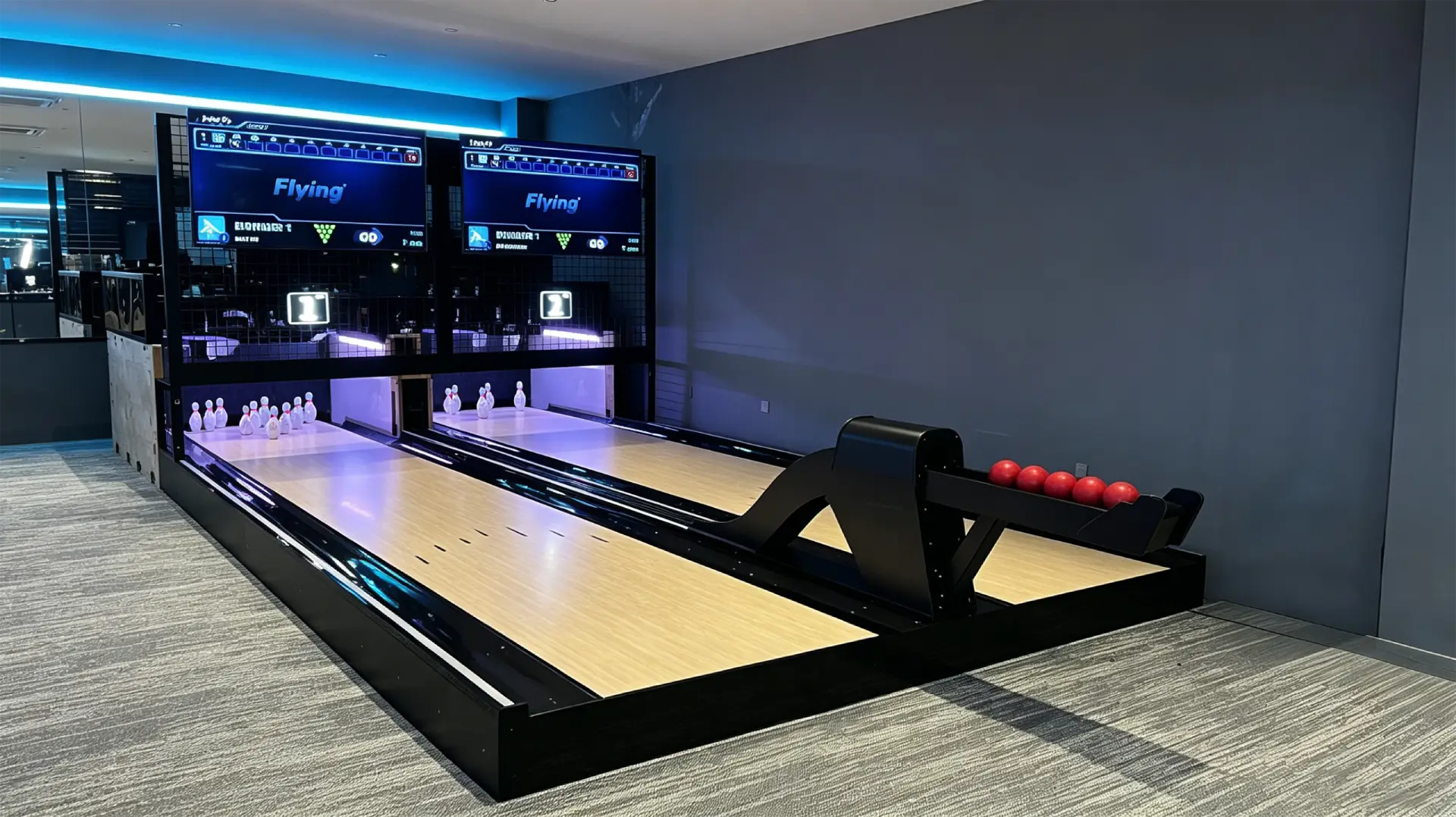
Flying Smart Duckpin Bowling Equipment for Commercial Venues
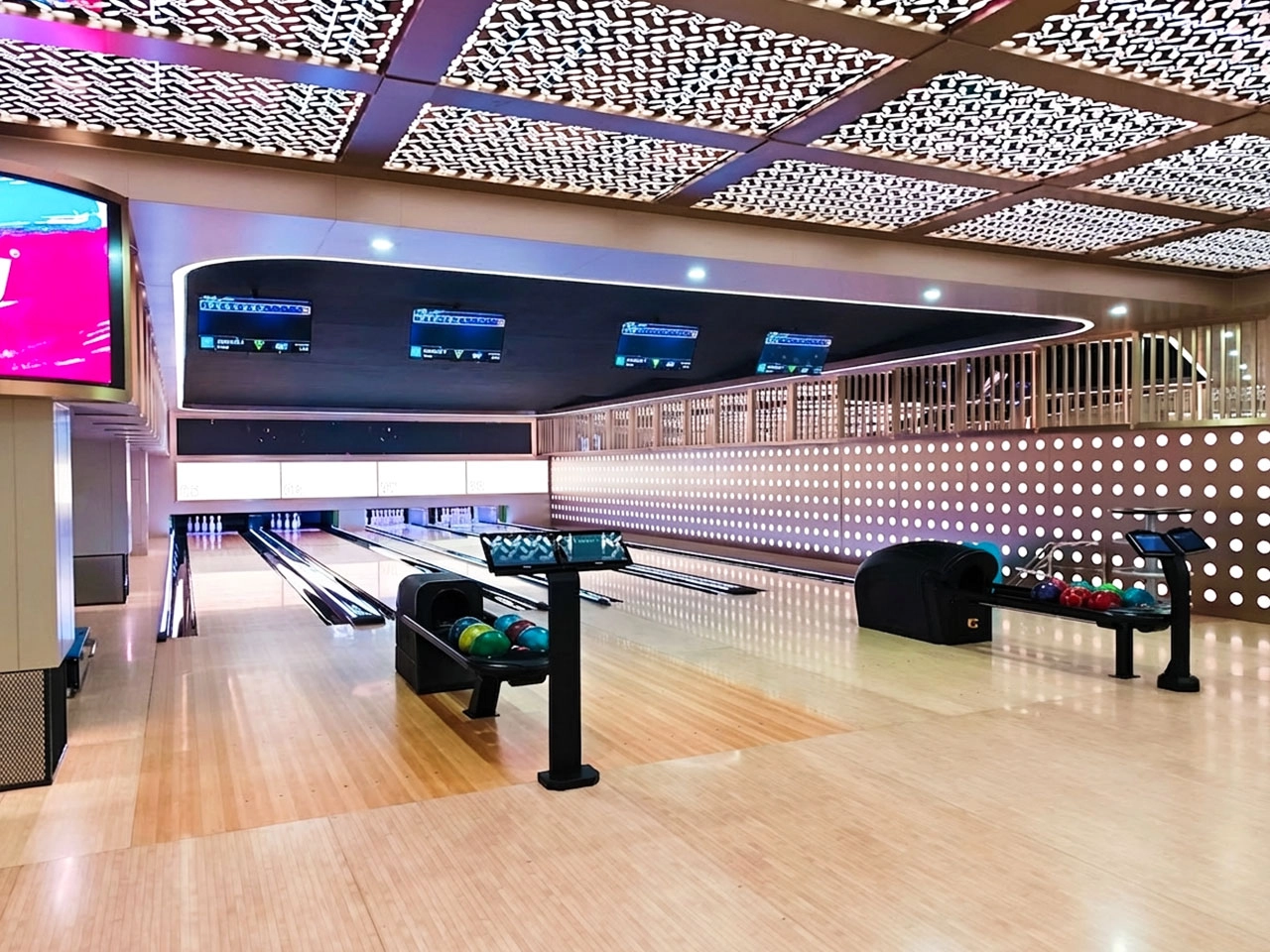
Complete Bowling Alley Equipment Package for Commercial Bowling Centers
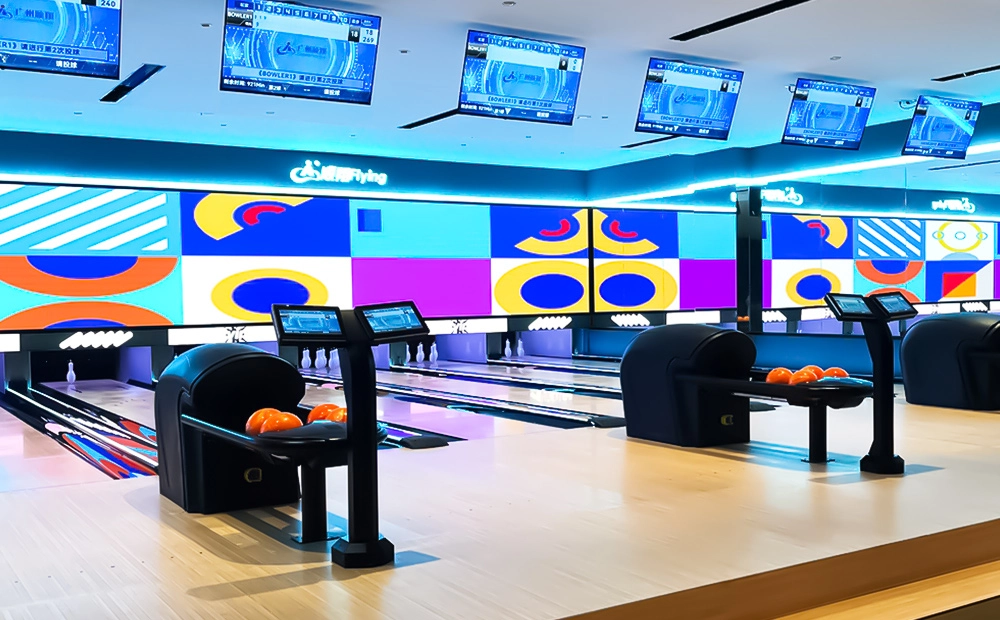
Medium Bowling Equipment for Compact Social Venues
You may also like
Build a commercial bowling venue with Flying’s complete string pinsetter bowling alley equipment package. The system includes the AEROPIN™ USBC-certified string pinsetter, customizable lanes, automatic scoring, ball return, lane lighting, pins, control hardware, and overseas installation support.
Designed for commercial bowling centers, family entertainment venues, hotels, resorts, bars, and premium private projects, this turnkey bowling system helps operators reduce sourcing complexity and prepare for reliable long-term operation.
Flying Smart Duckpin Bowling is a compact duckpin bowling equipment system designed for bars, family entertainment centers, hotels, resorts, cinemas, boutique bowling alleys, and social entertainment venues. With a standard 9.13m duckpin bowling lane, 1.25kg lightweight balls, automatic scoring, ball return, LED lighting, and a smart string pinsetter, it creates a fast-paced and easy-to-play bowling experience in a smaller footprint than traditional bowling.
The system is available as a turnkey duckpin bowling package, including lane equipment, a string pinsetter system, scoring hardware, control software, global shipping, installation guidance, and technical support.
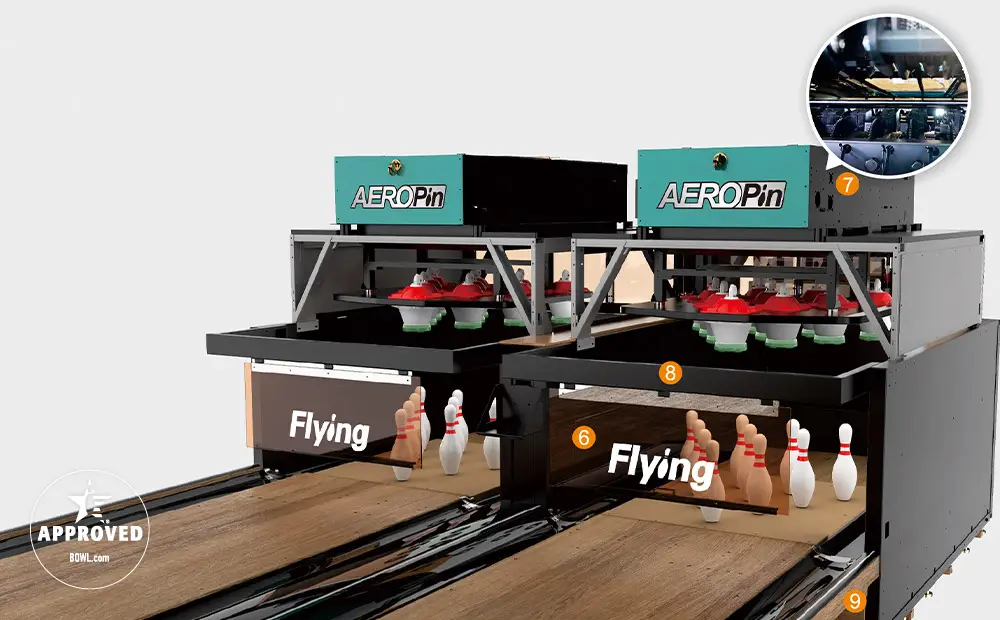
AEROPIN is Flying Bowling’s USBC-certified string pinsetter system for modern commercial bowling centers. Designed for fast pin setting, smooth ball return, low maintenance, and stable daily operation, it helps venue operators build league-ready and entertainment-focused bowling projects with confidence.
Flying Social Medium Bowling is a compact medium bowling equipment system designed for bars, cafes, family entertainment centers, community leisure venues, hotels, resorts, and small indoor entertainment spaces. With customizable lane lengths from 9.6m to 18m, small balls, lighter pins, string pinsetter technology, ball return, and automatic scoring, it creates an easy-to-play social bowling experience for players of different ages and skill levels.
Compared with full-size standard bowling, medium bowling requires less space and offers a more casual, interactive format. It is a practical choice for venues that want to add a bowling attraction without building a full commercial bowling alley.
Contact Flying
Start your bowling alley project
If you contact us now for more details, we can provide you with a custom bowling alley service. Our service team will get back to you within 24 hours normally!
© 2026 Flying BOWLING. Designed by gooeyun.
FOLLOW US:

Flying Bowling
Flying Bowling
Flyingbowling
Flyingbowling
Flyingbowling