

Building a 12-Lane Bowling Alley: 2026 Complete Cost Breakdown & Profit Guide
12 lanes is the commercial bowling sweet spot — large enough to run leagues and corporate events simultaneously, compact enough to keep staffing costs proportionate. But the total investment for a 12-lane build spans from $242,000 for a Duckpin format to over $800,000 for a premium Tenpin venue. This guide gives you the precise breakdown: equipment by format, freight and import duties by destination market, space requirements, and a three-scenario ROI model showing what break-even actually looks like in the real world.
- 1. The Bottom Line: What Does a 12-Lane Bowling Alley Cost in 2026?
- 2. Complete Cost Breakdown by Category
- 3. Landed Cost by Market: Freight and Import Duties
- 4. Space Requirements for a 12-Lane Setup
- 5. String Pinsetter vs. Free-Fall: The Right Technology Choice
- 6. Profitability Model: Three Scenarios for 12 Lanes
- 7. Case Study: 12-Lane Center at Middelburg Mall, Mpumalanga, South Africa
- 8. FAQ: 8 Questions Investors Ask About 12-Lane Projects {#faq}
- 9. Start Your 12-Lane Project
Looking for a broader comparison across all lane counts and formats?
See our complete guide: How Much Does It Cost to Build a Bowling Alley in 2026?
Building a 12-lane bowling alley is one of the most scalable investments in the family entertainment industry. For shopping malls, resorts, and Family Entertainment Centers (FECs), a 12-lane configuration hits a proven sweet spot: large enough to host leagues and corporate events, manageable enough to keep staffing and overhead proportionate, and compelling enough as an anchor attraction to drive footfall from adjacent retail.
But a successful project requires more than buying the right equipment. You need to understand the full cost of ownership from day one — equipment, logistics, site preparation, hidden costs, and the realistic revenue model that determines when you break even.
As a manufacturer with over 20 years of experience delivering turnkey bowling solutions across 40+ countries, Flying Bowling provides the real numbers here — not the optimistic estimates, and not the vague ranges you find everywhere else.
1. The Bottom Line: What Does a 12-Lane Bowling Alley Cost in 2026?
Based on 2026 project data, the total investment to open a fully operational 12-lane bowling alley — excluding building rent and local permits — typically ranges from $250,000 to $650,000 USD.
The range is wide because it spans two meaningfully different configurations:
- Lower end ($250K–$400K): Duckpin or Mini Bowling format, string pinsetter, standard interior fit-out, existing commercial space with adequate electrical infrastructure
- Upper end ($450K–$650K): Standard Tenpin format with USBC-certified string pinsetters, premium interior, full construction in a purpose-built space
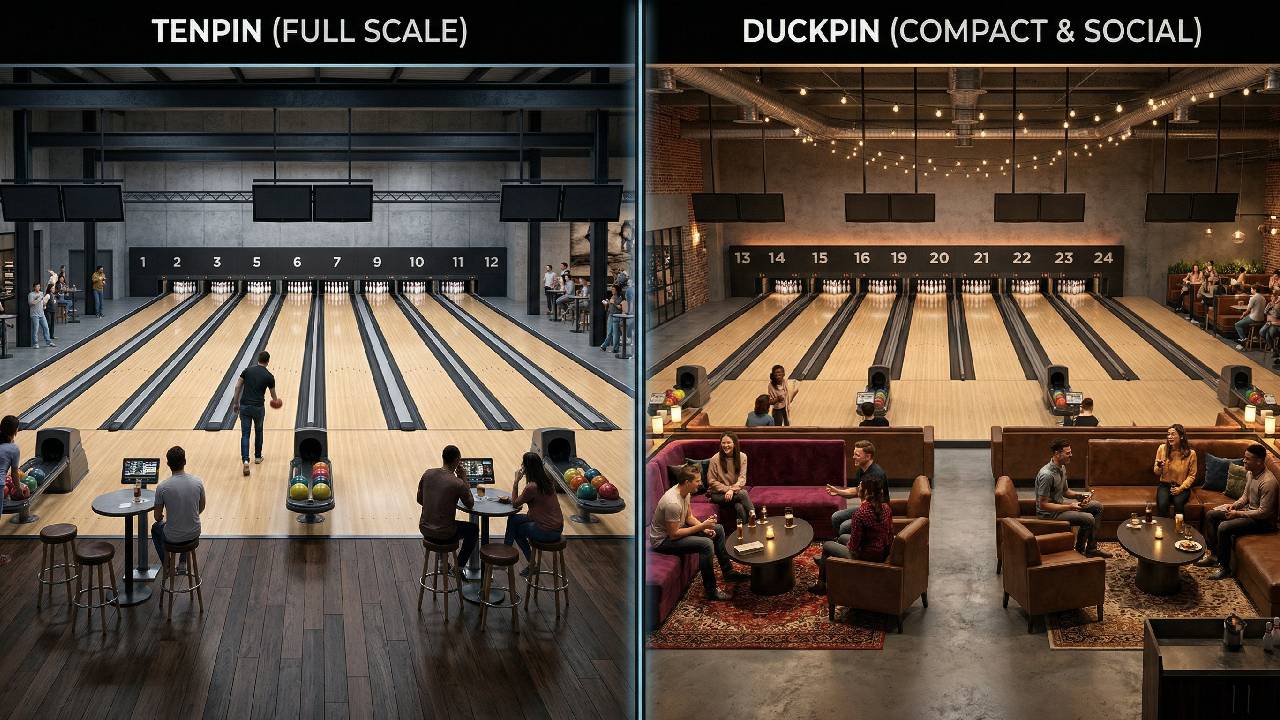
The single biggest cost lever within this range is format choice — not interior specification. Choosing Duckpin over Standard Tenpin can reduce equipment cost alone by 35–45%.
2. Complete Cost Breakdown by Category
Many suppliers quote only the equipment price. Here is the full picture.
Standard Tenpin — 12-Lane Budget Estimate
| Cost Category | Low Range | High Range | What's Included |
|---|---|---|---|
| Bowling equipment (FOB China) | $320,000 | $500,000 | Lanes, string pinsetters, ball returns, scoring systems, masking units |
| Shipping & logistics | $20,000 | $40,000 | Ocean freight, customs clearance, inland delivery |
| Professional installation | $15,000 | $35,000 | Flying engineers' travel and labor for full installation |
| Interior & furnishings | $50,000 | $150,000 | Seating, ball racks, carpeting, lighting, glow lane effects |
| Site construction & prep | $30,000 | $80,000 | Lane sub-floor leveling, soundproofing, electrical circuits |
| IT & POS systems | $10,000 | $25,000 | Booking software, front-desk management, shoe rental tracking |
| Total (Standard Tenpin) | $445,000 | $830,000 |
Duckpin / Mini Format — 12-Lane Budget Estimate
| Cost Category | Low Range | High Range | Notes |
|---|---|---|---|
| Bowling equipment (FOB China) | $145,000 | $240,000 | Significantly lower than Tenpin due to compact lane design |
| Shipping & logistics | $15,000 | $28,000 | Lower volume than Tenpin equipment |
| Professional installation | $12,000 | $25,000 | Faster installation due to simpler lane structure |
| Interior & furnishings | $40,000 | $120,000 | |
| Site construction & prep | $20,000 | $55,000 | Shorter lanes require less sub-floor area |
| IT & POS systems | $10,000 | $22,000 | |
| Total (Duckpin / Mini) | $242,000 | $490,000 |
The 15% Contingency Rule: Always add 15% to your construction and fit-out budget for unexpected costs — fire safety compliance, electrical capacity upgrades, structural surprises. Equipment costs are predictable; local construction costs are not. This contingency has saved every project we have ever worked on from a mid-build financial crisis.
3. Landed Cost by Market: Freight and Import Duties
The FOB equipment price is only the starting point. Your actual landed cost depends heavily on your destination market. Here are the realistic additions for the most common Flying Bowling markets.
| Destination Market | Ocean Freight (12 lanes) | Import Duty Rate | Typical Total Addition |
|---|---|---|---|
| United States | $12,000–$20,000 | 0–5% on equipment | +$25,000–$48,000 |
| European Union | $10,000–$18,000 | 2–8% on equipment | +$22,000–$55,000 |
| Southeast Asia | $5,000–$10,000 | 0–15% (varies by country) | +$12,000–$55,000 |
| Middle East (GCC) | $6,000–$12,000 | 5% standard | +$25,000–$45,000 |
| Africa | $8,000–$15,000 | 10–25% (varies widely) | +$40,000–$90,000 |
| Australia / NZ | $10,000–$16,000 | 0–5% | +$20,000–$38,000 |
Africa note: Import duties in many African markets are substantially higher than other regions. For projects in Sub-Saharan Africa, budget for import duties at the higher end of the range and factor in potential customs delays (2–4 weeks additional lead time versus other markets).
4. Space Requirements for a 12-Lane Setup
One of the most common early-stage project mistakes is committing to a space before confirming it physically accommodates 12 lanes with proper player and staff flow.
Standard Tenpin — 12-Lane Dimensions
- Lane pair width: 3.45 meters (2 lanes + shared ball return)
- Total width for 12 lanes: 21–22 meters (6 pairs × 3.45m + perimeter clearance)
- Total room depth: Minimum 30.5 meters (approach area + 18.3m lane + machine area + backstop)
- Recommended total area: 650–800 sqm including front desk, seating, and service corridors
- Minimum ceiling height: 3.5 meters clear (3.0 meters minimum with modified overhead design)
Duckpin — 12-Lane Dimensions (Flying FSDB, 9.2m lane)
- Total width for 12 lanes: 18–20 meters
- Total room depth: Minimum 16 meters (approach + 9.2m lane + machine area)
- Recommended total area: 380–480 sqm — approximately 40% less floor area than Tenpin
- Ceiling height: 2.8 meters minimum
The Duckpin format's significantly smaller footprint is why it's increasingly the format of choice for shopping mall integrations, hotel entertainment floors, and urban FECs where floor space comes at a premium.
Request a CAD layout: Flying Bowling provides custom 2D floor plans for your specific space dimensions at no cost as part of the project consultation process. Contact us with your venue measurements →
5. String Pinsetter vs. Free-Fall: The Right Technology Choice
Why Most New Centers Choose String Technology
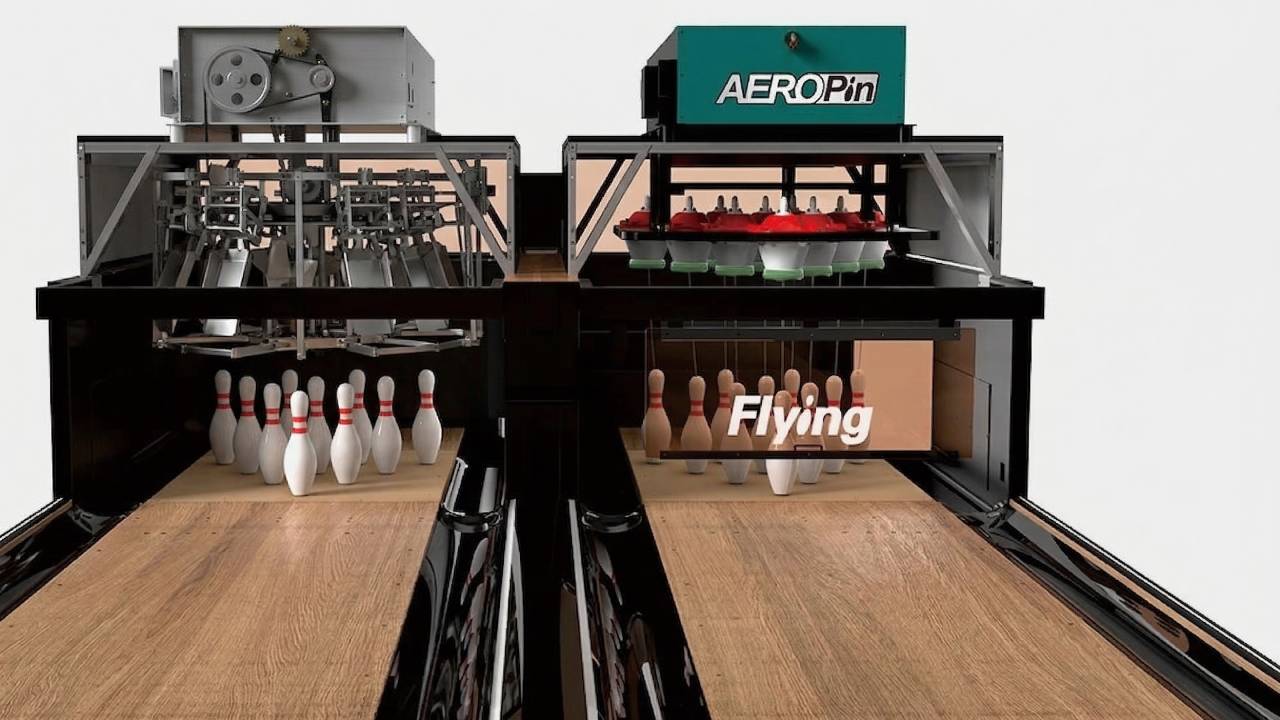
The shift away from traditional free-fall pinsetters toward string systems is one of the clearest trends in new bowling venue construction. The reasons are practical and financial, not aesthetic.
- Mechanical complexity: String pinsetters use approximately 40–60 moving components per lane, compared to 150–200+ in a free-fall system — roughly 60–70% fewer parts. Fewer parts means fewer failure points, less frequent servicing, and a dramatically lower skill threshold for routine maintenance.
- Maintenance cost: The annual maintenance cost saving for a 12-lane venue switching from free-fall to string pinsetters is estimated at $30,000–$80,000 per year — primarily from the elimination of specialized technician requirements. Free-fall systems require certified mechanics; most string system maintenance can be handled by a trained venue technician.
- Energy consumption: String pinsetters consume approximately 40–60% less electricity than equivalent free-fall systems, primarily because they eliminate the power-intensive pin elevator and distributor mechanisms of the free-fall cycle.
- Reset speed: String systems complete a reset cycle in 3–5 seconds versus 8–12 seconds for free-fall. For a 12-lane venue running at full capacity, this faster cycle translates to approximately 10–15% more frames per hour per lane — a direct revenue capacity increase.
- Noise: String systems operate at approximately 55–65 dB during the reset cycle versus 75–85 dB for free-fall — a 20 dB reduction that is perceptible as roughly 4× quieter. Critical for mixed-use venues, hotel integrations, and open-plan entertainment centers.
The One Scenario Where Free-Fall Still Makes Sense
If your venue is specifically positioning around professional PBA-level tournament hosting and your league audience demands traditional free-fall authenticity, that is a legitimate market positioning choice. For all other commercial use cases — entertainment FECs, resort venues, social bowling, mixed-age facilities — string pinsetters offer superior long-term economics.
For venues requiring competitive certification alongside string technology, Flying's AEROPIN system holds USBC certification — approving it for sanctioned league and tournament play. This eliminates the last remaining argument against string systems for competition-focused venues.
6. Profitability Model: Three Scenarios for 12 Lanes
The single-scenario revenue model common in the industry — "assume full capacity, calculate revenue" — is not useful for investment decisions. Here is a realistic three-scenario model based on Flying Bowling's project data.
Assumptions
- Lane rental rate: $25–$30 per lane per hour (US/Western market mid-range)
- Operating hours: 8 hours/day, 6 days/week (2,496 hours/year)
- F&B and ancillary revenue: 35% uplift on lane rental revenue
- Annual operating costs (12 lanes): $220,000–$280,000 (rent excluded)
- Total investment: $550,000 (mid-range Tenpin build)
Three-Scenario Revenue Model
| Scenario | Lane Utilization | Weekly Lane Revenue | Monthly Total Revenue (incl. F&B) | Monthly Net Profit | Payback Period |
|---|---|---|---|---|---|
| Conservative | 35% | $5,040 | $27,720 | $4,887 | ~9.4 years |
| Realistic | 55% | $7,920 | $43,560 | $20,727 | ~2.2 years |
| Optimistic | 75% | $10,800 | $59,400 | $36,567 | ~1.3 years |
Reading this table: The "conservative" scenario assumes a new standalone venue with no prior foot traffic that takes 12–18 months to reach stable utilization. The "realistic" scenario is typical for a venue integrated into an existing mall or FEC with established foot traffic. The "optimistic" scenario reflects a well-located venue in a market with limited bowling competition after 2+ years of operation.
The Key Insight for 12-Lane Specifically
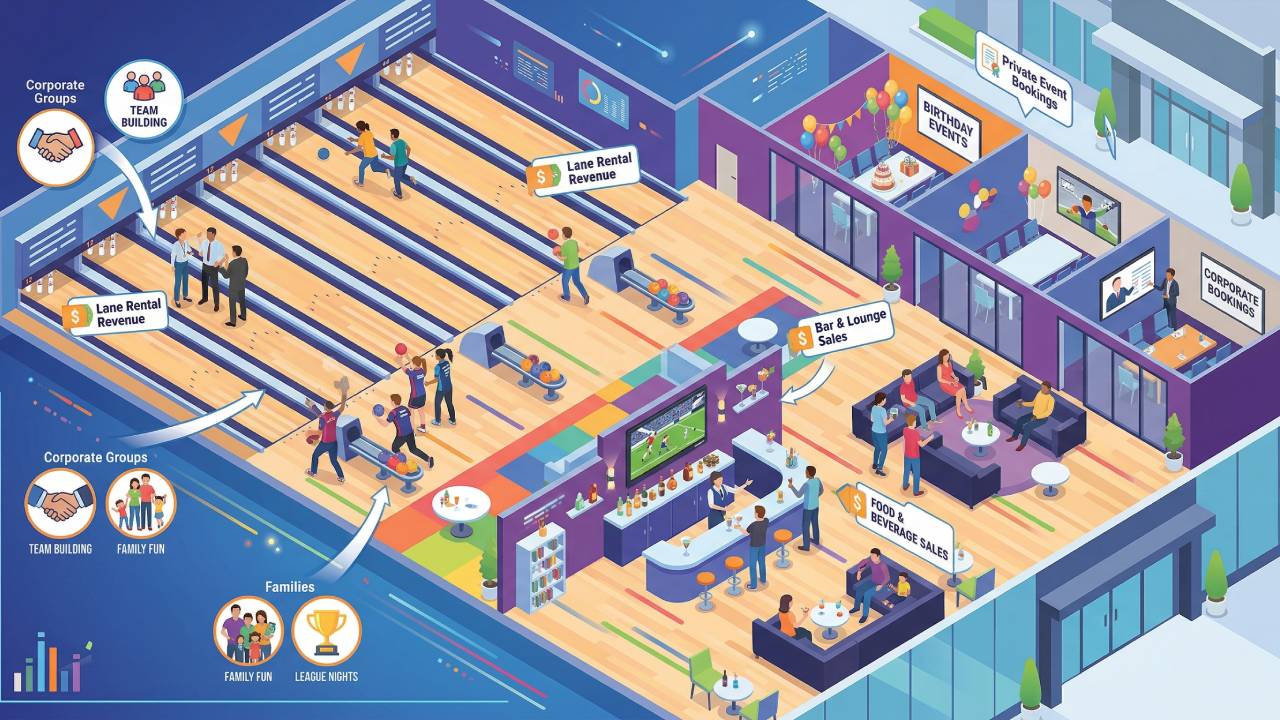
At 12 lanes, a venue can support both walk-in recreational play and structured programming (league nights, corporate events, birthday party bookings) simultaneously without one cannibilizing the other. This dual-use capability is what makes 12 lanes the commercial sweet spot: 4–6 lane venues are too small for meaningful corporate event revenue; 20+ lane venues carry proportionally higher fixed costs. At 12 lanes, you can fill off-peak weekday slots with corporate bookings while keeping weekend capacity open for walk-in families — the revenue diversification that drives the realistic scenario above.
Revenue Acceleration Strategies for 12-Lane Venues
- League programming: 12 lanes can support 3–4 simultaneous league teams during a dedicated league night. Weekly league programs generate predictable, recurring revenue — typically $800–$1,500 per league night — and create a loyal customer base that fills off-peak slots.
- Corporate events: Boardroom bowling (2 hours, 12–20 participants) typically commands $600–$1,200 per booking. A 12-lane venue can host multiple corporate groups simultaneously, making Thursday and Friday daytime slots significantly more valuable than a small-format venue can achieve.
- Birthday party packages: 2-hour party with 2 lanes, food package, and dedicated staff: $250–$450 per booking. With 12 lanes, you can run multiple party bookings simultaneously on Saturday afternoons without disrupting general public access.
7. Case Study: 12-Lane Center at Middelburg Mall, Mpumalanga, South Africa
The Challenge: In 2025, a client in South Africa wanted Install a community bowling center in Middelburg Mall. The local power grid was unstable, and the budget was tight.
The Flying Bowling Solution:
- Energy Solution: We installed our low-voltage String Pinsetters, which operate on standard power, eliminating the need for expensive electrical transformers.
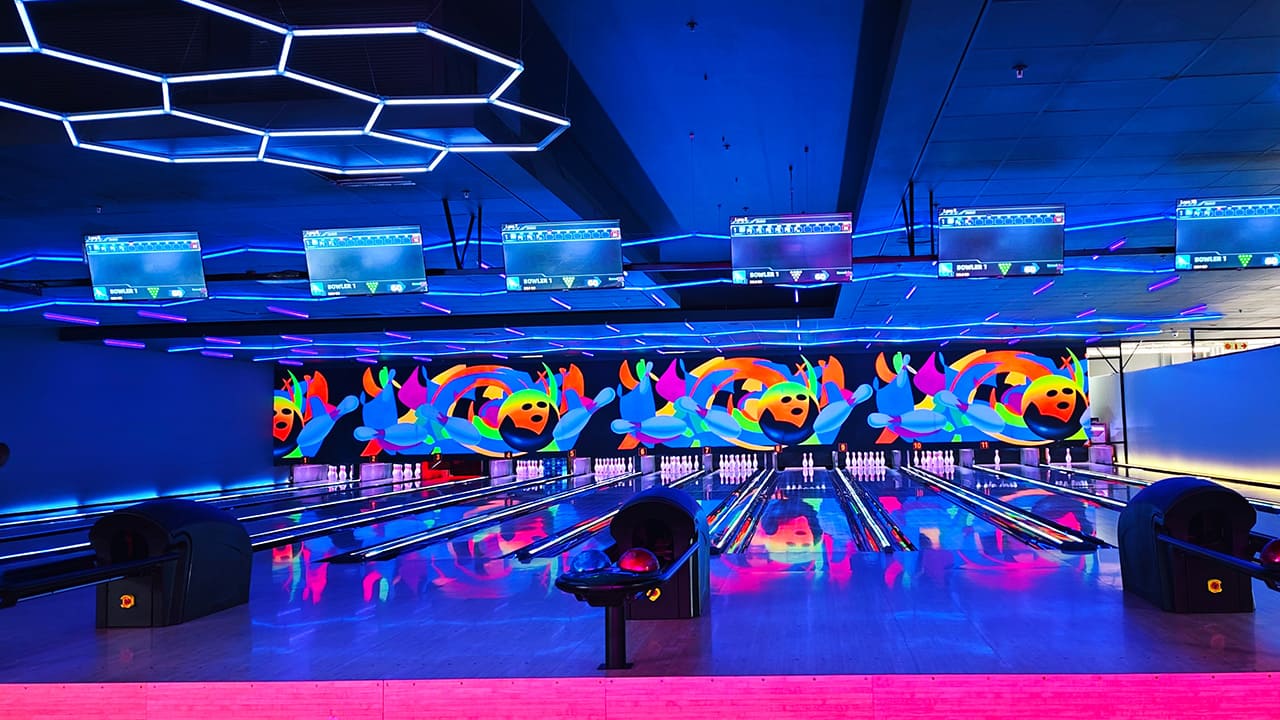
- Visual Impact: We utilized custom UV Glow Lanes, turning the venue into a "Cosmic Bowling" destination at night to attract a younger demographic.
- The Result: The project was completed for under $180,000 in equipment costs, and the venue welcomed over 5,000 visitors in its first month.
The Project
In 2025, Flying Bowling partnered with an operator in Middelburg, South Africa, to install a community bowling center within the Middelburg Mall. The project presented two significant challenges common to emerging market installations: an unstable local power grid and a constrained capital budget.
The Solutions
Power grid challenge: Flying's string pinsetter systems operate on standard low-voltage power, eliminating the need for the heavy-duty electrical infrastructure required by traditional free-fall pinsetter systems. This removed the need for expensive voltage stabilizers and transformer upgrades — a cost saving that was critical for making the project financially viable within the client's budget.
Budget constraint: By specifying Flying's string pinsetter equipment and optimizing the interior specification for the local market, the total equipment cost was kept under $180,000 — substantially below what a comparable free-fall installation would have required.
Venue differentiation: Flying's team specified UV-reactive lane surfaces and glow bowling lighting, transforming the venue into a "Cosmic Bowling" destination during evening hours — differentiating it from a standard bowling center and driving a younger demographic during the 7pm–11pm time slot.
The Result
The venue opened on schedule and welcomed over 5,000 visitors in its first month of operation. The Cosmic Bowling evening format became the venue's signature product, generating premium pricing versus standard afternoon lane rates and establishing the center as the premier entertainment destination in Middelburg.
Based on typical performance for venues of this profile in comparable markets, a center of this type and foot traffic level would be expected to reach operating break-even within 18–24 months.
→ Read the full Middelburg Mall project case study
8. FAQ: 8 Questions Investors Ask About 12-Lane Projects {#faq}
Q1: How long does it take to build a 12-lane bowling alley from order to opening?
Total timeline is typically 14–22 weeks from order confirmation. Production and shipping takes 45–65 days; local construction runs concurrently with shipping for the most efficient schedule; installation requires 2–3 weeks on-site; soft opening preparation takes 1–2 weeks. Flying Bowling offers expedited production scheduling for projects with fixed opening deadlines — discuss your timeline requirements at the inquiry stage.
Q2: Is new equipment always better than used for a 12-lane project?
For new operators or operators in markets with limited local bowling equipment expertise, new equipment is strongly recommended. Used Tenpin equipment from closed US venues may be 20–30% cheaper at purchase, but typically lacks warranty coverage, has unknown maintenance history, and may have discontinued parts unavailable for models more than 8–10 years old. For a 12-lane project representing $250K–$650K total investment, the risk profile of used equipment — particularly in markets far from reliable service networks — generally outweighs the initial cost saving.
Q3: What ceiling height does a 12-lane bowling alley require?
For Standard Tenpin, Flying recommends a clear ceiling height of at least 3.5 meters to comfortably accommodate overhead scoring monitors, ambient lighting installations, and to create an open, inviting atmosphere. The absolute minimum for pinsetter operation is 3.0 meters, which Flying can design for with modified overhead monitor placement. For Duckpin format, 2.8 meters is the practical minimum.
Q4: Can a 12-lane venue support competitive league play?
Yes — with the right equipment specification. Flying's AEROPIN string pinsetter is USBC certified, making it approved for sanctioned league and tournament play. For venues planning to host regular leagues, we recommend specifying AEROPIN rather than the standard FUSB system. Duckpin format lanes can also support competitive play under Duckpin-specific regulations, though no international governing body equivalent to USBC exists for Duckpin.
Q5: How many staff does a 12-lane bowling alley need?
A typical 12-lane venue during peak operations requires: 1 front-desk/POS operator, 1 floor attendant managing lane assignments and minor equipment issues, and 1 F&B staff member if food and beverage service is offered. During off-peak periods, one person can often manage front desk and floor simultaneously. For league nights or large corporate events, add 1–2 additional floor staff. String pinsetter systems significantly reduce the technical staff requirement compared to free-fall venues — no dedicated full-time pinsetter mechanic is required.
Q6: What is the minimum space required for 12 Tenpin lanes?
The absolute minimum footprint for 12 Standard Tenpin lanes — without comfortable player seating or generous concourse space — is approximately 22m × 30m (660 sqm). Flying recommends planning for 700–800 sqm to allow for adequate player experience quality. Duckpin format 12-lane venues can fit in 380–480 sqm — significantly more space-efficient for mall and urban venue contexts.
Q7: What financing options are available for bowling alley equipment?
Equipment financing options vary by market. Common approaches used by Flying Bowling clients include: commercial bank equipment loans (typically requiring 20–30% down payment), lease-to-own arrangements for equipment (available in some markets through Flying's partner network), and phased builds starting with 6 lanes and expanding to 12 lanes once initial revenue is established. Flying's project team can advise on financing structures used by clients in your specific market.
Q8: What ongoing operational costs should I budget annually for 12 lanes?
For a 12-lane Standard Tenpin venue, annual operating costs (excluding building rent) typically include: equipment maintenance $20,000–$40,000; staff $120,000–$200,000; utilities $35,000–$70,000; marketing $15,000–$40,000; insurance $10,000–$25,000; consumables and replacement parts $8,000–$18,000. Total range: $208,000–$393,000 annually. Duckpin and Mini format venues have meaningfully lower maintenance and energy costs due to lighter equipment and shorter lanes.
9. Start Your 12-Lane Project
A 12-lane bowling alley is a proven investment in the right location with the right format choice. The difference between a venue that reaches break-even in 18 months and one that struggles for 4+ years is not the equipment — it's the planning: accurate budget, right format for the audience, and a venue design that enables the revenue diversification that drives profitability.
Flying Bowling provides end-to-end project support from first enquiry to opening day: custom CAD floor plans, equipment specification, FOB and landed cost quotations, logistics coordination, installation supervision, and ongoing technical support.
Get a precise budget for your 12-lane project:
-
→ Request a free consultation and custom 3D layout Tell us your target country, available floor space, and preferred format. We'll provide a complete equipment specification, accurate cost breakdown, and space plan within 24 hours.
Further reading:
-
→ Full bowling alley cost guide — all formats and lane counts
-
→ String pinsetter vs. free-fall: complete technical comparison
-
→ Explore Flying's standard bowling equipment range
Flying Bowling has manufactured and installed bowling equipment across 40+ countries since 2005, with over 3,000 commercial lane installations completed globally. Our AEROPIN string pinsetter is USBC certified.
Recommended products
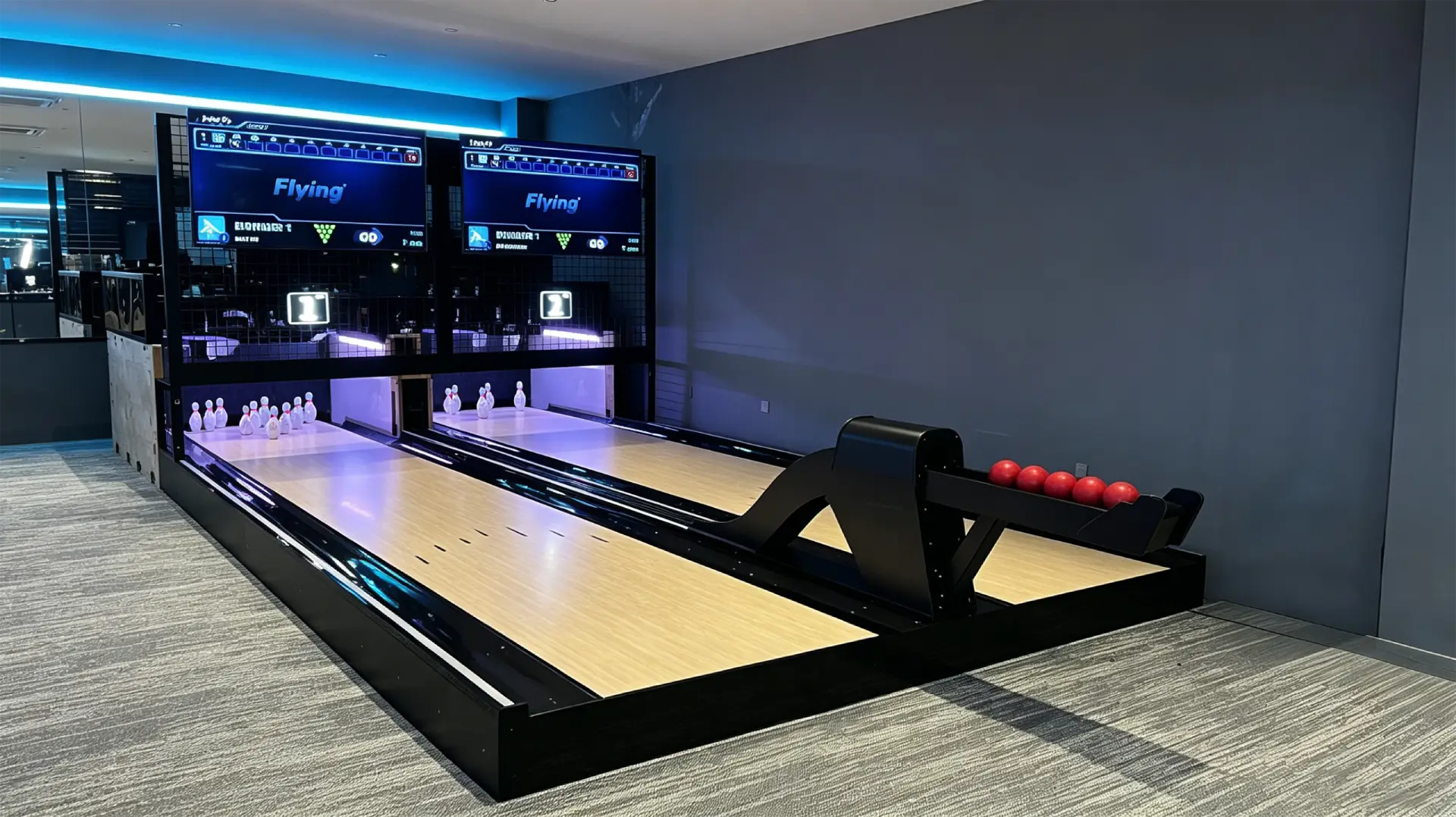
Flying Smart Duckpin Bowling Equipment for Commercial Venues
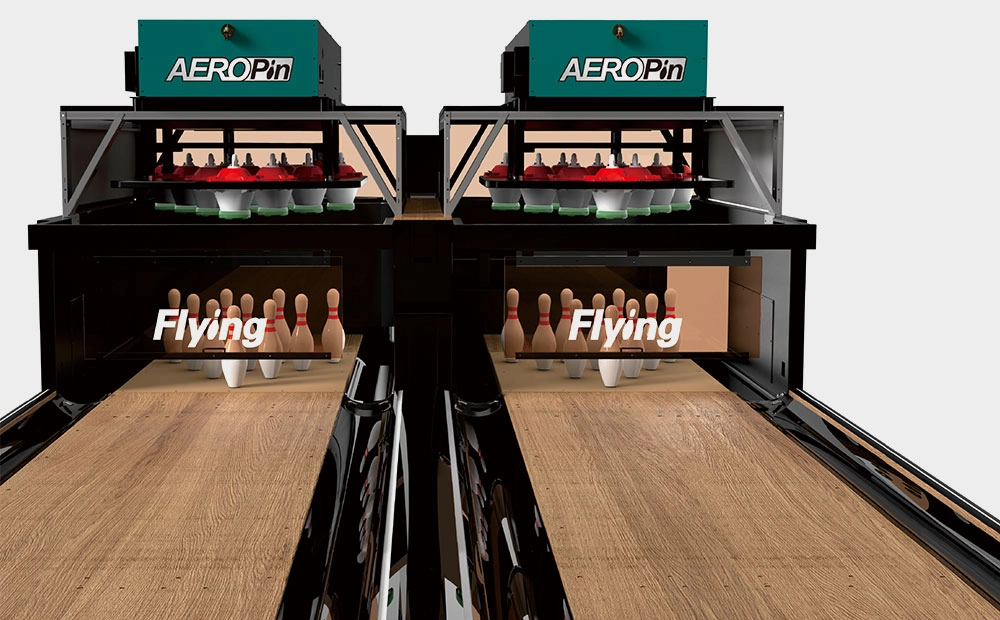
AEROPIN™ USBC-Certified String Pinsetter System
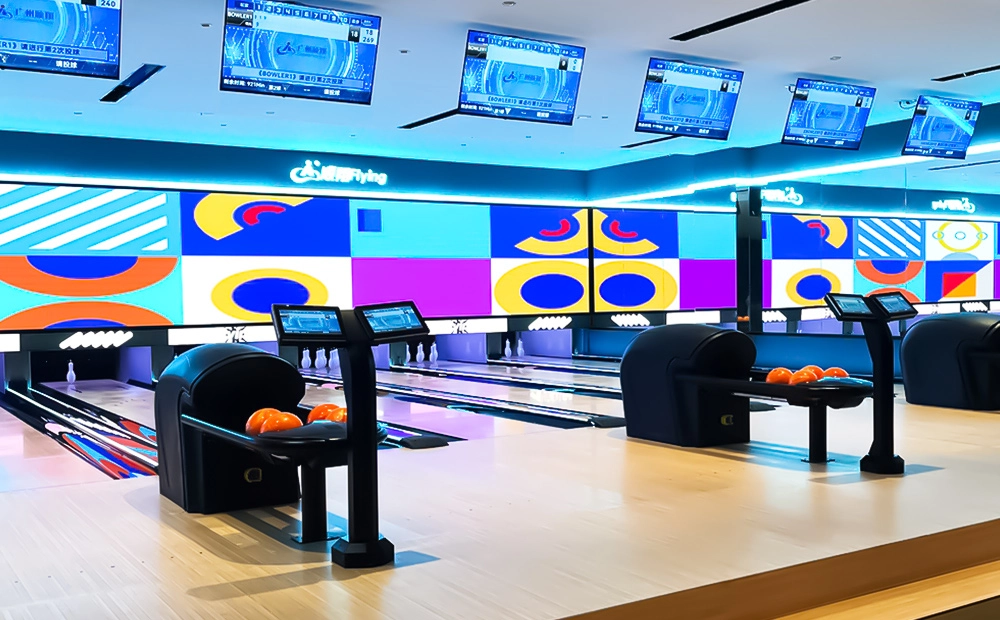
Medium Bowling Equipment for Compact Social Venues
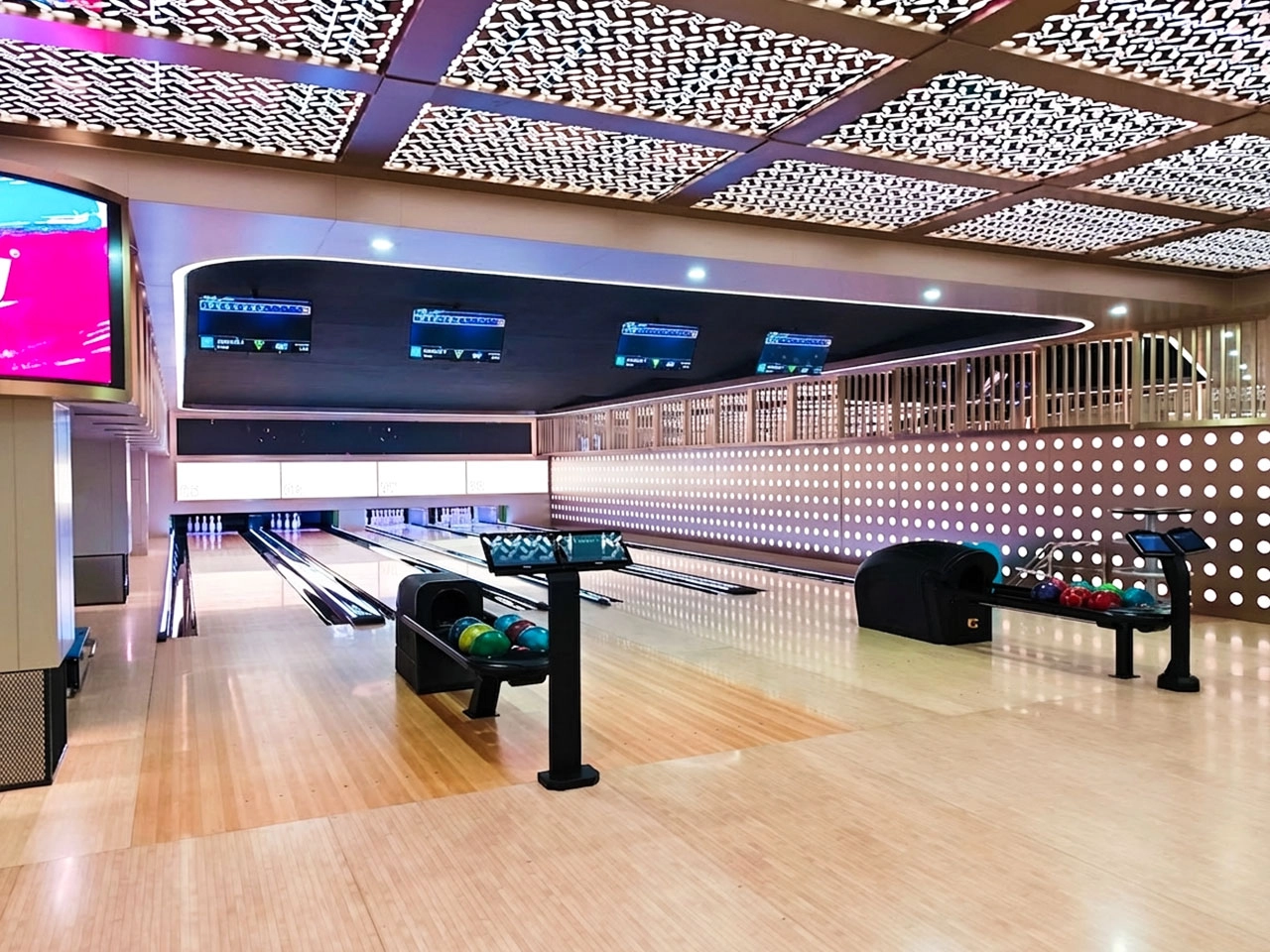
Complete Bowling Alley Equipment Package for Commercial Bowling Centers
You may also like
Build a commercial bowling venue with Flying’s complete string pinsetter bowling alley equipment package. The system includes the AEROPIN™ USBC-certified string pinsetter, customizable lanes, automatic scoring, ball return, lane lighting, pins, control hardware, and overseas installation support.
Designed for commercial bowling centers, family entertainment venues, hotels, resorts, bars, and premium private projects, this turnkey bowling system helps operators reduce sourcing complexity and prepare for reliable long-term operation.
Flying Smart Duckpin Bowling is a compact duckpin bowling equipment system designed for bars, family entertainment centers, hotels, resorts, cinemas, boutique bowling alleys, and social entertainment venues. With a standard 9.13m duckpin bowling lane, 1.25kg lightweight balls, automatic scoring, ball return, LED lighting, and a smart string pinsetter, it creates a fast-paced and easy-to-play bowling experience in a smaller footprint than traditional bowling.
The system is available as a turnkey duckpin bowling package, including lane equipment, a string pinsetter system, scoring hardware, control software, global shipping, installation guidance, and technical support.
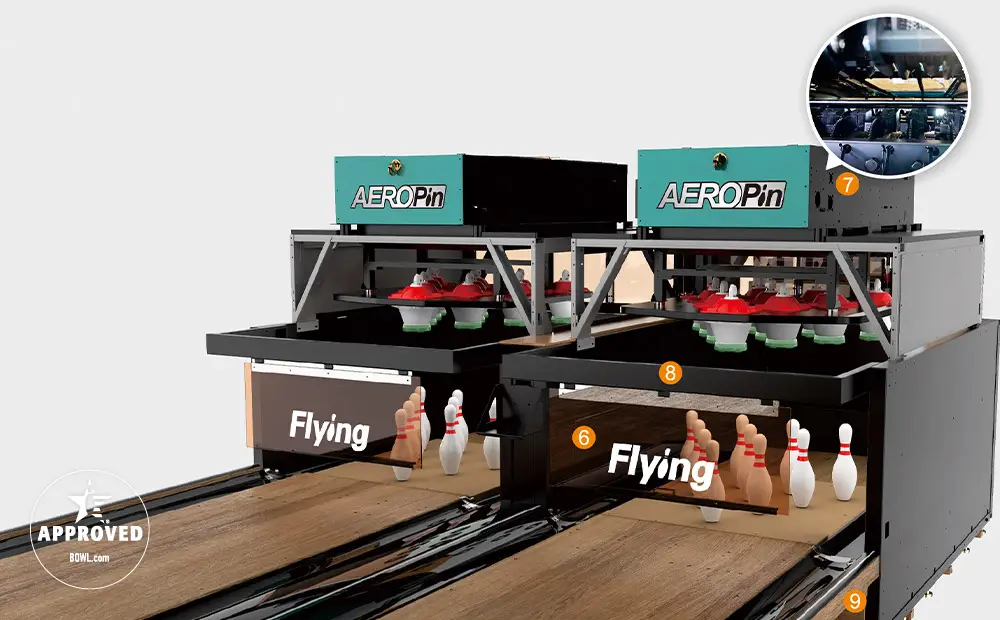
AEROPIN is Flying Bowling’s USBC-certified string pinsetter system for modern commercial bowling centers. Designed for fast pin setting, smooth ball return, low maintenance, and stable daily operation, it helps venue operators build league-ready and entertainment-focused bowling projects with confidence.
Flying Social Medium Bowling is a compact medium bowling equipment system designed for bars, cafes, family entertainment centers, community leisure venues, hotels, resorts, and small indoor entertainment spaces. With customizable lane lengths from 9.6m to 18m, small balls, lighter pins, string pinsetter technology, ball return, and automatic scoring, it creates an easy-to-play social bowling experience for players of different ages and skill levels.
Compared with full-size standard bowling, medium bowling requires less space and offers a more casual, interactive format. It is a practical choice for venues that want to add a bowling attraction without building a full commercial bowling alley.
Contact Flying
Start your bowling alley project
If you contact us now for more details, we can provide you with a custom bowling alley service. Our service team will get back to you within 24 hours normally!
© 2026 Flying BOWLING. Designed by gooeyun.
FOLLOW US:

Flying Bowling
Flying Bowling
Flyingbowling
Flyingbowling
Flyingbowling