


How Many Players Can Play in One Lane? Rules, Recommendations & Setup Tips
Most bowling lanes accommodate 4 to 6 players for the best experience. The standard maximum at most commercial venues is 8 players per lane, though game duration and wait times increase significantly above 6. The right number depends on your group type, bowling format and whether you are playing for fun or in a league.
- 1. How Many People Per Lane? Quick Capacity Reference
- 2. Game Duration by Group Size
- 3. Recommended Players by Bowling Format
- 4. Planning for Specific Group Types
- 5. How Many Lanes Does Your Group Need?
- 6. Planning a Bowling Venue? Capacity Affects Lane Layout and ROI
- 7. Social Play vs. Competitive Play: Different Needs
- 8. Kids and Family Bowling Lane Capacity
- 9. For Venue Operators: Lane Efficiency and Group Management
- 10. How We Estimated These Guidelines
- FAQ
Quick Answer
Most bowling lanes work best with 4–6 players per lane. Many commercial venues allow up to 8 players, but games become noticeably slower above 6. For groups of 10 or more, splitting across multiple lanes gives a much better experience.
The best lane allocation depends on your group type, bowling format, game duration, and whether the session is casual, competitive, or part of a commercial venue plan. This guide explains capacity by group size, game time, bowling format, event type, and venue layout needs.
1. How Many People Per Lane? Quick Capacity Reference
| Players per Lane | Experience | Game Speed | Best For |
|---|---|---|---|
| 1–2 | Excellent | Fast (~20–30 min) | Practice, dates, quick sessions |
| 3–4 | Great | Comfortable (~40–50 min) | Small groups, league play, casual friends |
| 5–6 | Good | Standard (~60–70 min) | Birthday parties, family outings, work events |
| 7–8 | Acceptable | Slow (~80–100 min) | Large casual groups, party packages |
| 9+ | Not recommended | Very slow | Avoid — significant wait time between turns |
The most common recommendation across commercial bowling venues worldwide is 4–6 players per lane. This range balances game pace, social engagement and wait time between turns. At 4 players, each person bowls roughly every 10–12 minutes. At 8 players, that gap extends to 20–25 minutes — long enough for attention to drift.
Most venues set 8 players as the formal maximum, primarily for casual events and birthday party packages where socializing matters more than pace.
2. Game Duration by Group Size
A single game of ten-pin bowling lasts 10 frames per player. Each frame takes roughly 2–3 minutes, but the cumulative total per game grows quickly with more players.
| Group Size | Estimated Time per Game | Notes |
|---|---|---|
| 2 players | 20–30 minutes | Fast-paced; good for back-to-back games |
| 3 players | 30–40 minutes | Comfortable pace, everyone stays engaged |
| 4 players | 40–50 minutes | Standard social game |
| 5 players | 50–65 minutes | Good for parties; some downtime between turns |
| 6 players | 60–75 minutes | Common party format; pace slows noticeably |
| 7–8 players | 80–100 minutes | Works for casual events; wait times increase |
These estimates assume recreational play on a standard ten-pin lane. Duckpin and mini bowling formats move faster due to shorter distances and simpler scoring.
3. Recommended Players by Bowling Format
Different bowling formats have different ideal player counts, primarily because lane length, reset speed and game complexity vary.
Standard Ten-Pin Bowling
Standard ten-pin is the most common commercial format and accommodates the widest range of group sizes.
- › Ideal: 4–6 players
- › Maximum: 8 players
- › Minimum: 1 player (practice, date night)
- › League standard: 4–5 players per lane
The full 18.3-meter lane and heavier balls mean each frame takes slightly longer than compact formats. At 6 or more players, wait times between turns become noticeable.
Duckpin Bowling
Duckpin uses a shorter lane (~9.2 meters), smaller balls and smaller pins. The faster reset and simpler mechanics make for quicker turns.
- › Ideal: 3–5 players
- › Maximum: 6 players
- › Best for: Bars, cafés, compact entertainment venues, social groups
Flying Bowling's FSDB Duckpin Bowling system is designed for social venue formats where group dynamics and fast-paced fun take priority over capacity.
Mini Bowling
Mini bowling lanes are shorter still (typically 10–12 meters), with lighter balls and smaller pins designed for children and families.
- › Ideal: 2–4 players per lane
- › Maximum: 5–6 players
- › Best for: Kids zones, arcades, family entertainment areas, parent-child centers
Flying Bowling's FCMB Mini Bowling system uses 12-meter lanes with 1.25kg balls, optimized for children aged 3 and up.
Medium Bowling
Medium bowling (lane lengths between 9.6 and 18 meters, customizable) sits between standard and compact formats in both pace and capacity.
- › Ideal: 3–6 players
- › Maximum: 7–8 players
- › Best for: Community centers, bars, mid-size entertainment venues
Flying Bowling's FSMB Medium Bowling system supports variable lane lengths, making it adaptable for venues with space constraints that still want a full bowling experience.
4. Planning for Specific Group Types
Birthday Parties (6–16 People)
A group of 10 for a birthday party is one of the most common booking scenarios. The typical approach:
- › 10 people → 2 lanes of 5, or split into a lane of 6 and a lane of 4
- › Avoid putting all 10 on one lane — games take over 90 minutes and attention drops
- › Splitting into two lanes creates friendly competition between groups, which increases engagement
Most venues offer birthday packages that include 1–2 hours of lane time, shoes, and sometimes food. Lane allocations are usually calculated at 4–6 players per lane.
Corporate Team Events (10–40 People)
Corporate groups need structured lane allocation to prevent chaos. A practical formula:
- › Divide the total group by 4–6 to get the minimum number of lanes needed
- › For a group of 20: minimum 4 lanes at 5 players each
- › Consider running a tournament format across lanes to increase engagement
Flying Bowling's smart scoring systems support tournament modes and group leaderboards that work well for team building events.
Date Night or Small Friend Groups (2–4 People)
Two to four people is the optimal group size for a comfortable, social game where everyone stays involved. Games run in under an hour, leaving time for multiple rounds or other venue activities.
League Play (2–5 People)
Sanctioned league play is typically organized at 4–5 bowlers per lane. Most competitive leagues run 4-person teams, with each player bowling 3 games per session. At this format, pace and consistency matter — fewer players per lane means faster, more focused play.
5. How Many Lanes Does Your Group Need?
Use this table to determine minimum lane requirements for common group sizes.
| Group Size | Minimum Lanes (at 6/lane) | Recommended Lanes (at 4–5/lane) |
|---|---|---|
| 4–6 people | 1 lane | 1–2 lanes |
| 8–10 people | 2 lanes | 2–3 lanes |
| 12–16 people | 2–3 lanes | 3–4 lanes |
| 20 people | 4 lanes | 4–5 lanes |
| 30 people | 5 lanes | 6–8 lanes |
| 40+ people | 7+ lanes | 8–10 lanes |
For groups over 20, venue operators should calculate lane allocation at 4–5 per lane rather than 6–8, even if it means booking more lanes. The improvement in guest experience — shorter wait times, higher energy, more games per hour — typically increases food and beverage spend and rebooking rates.
6. Planning a Bowling Venue? Capacity Affects Lane Layout and ROI
For venue owners, lane capacity is not only a guest experience issue — it directly shapes floor planning, hourly revenue, party package design and equipment configuration.
The number of lanes you install determines how many guests you can serve simultaneously. A venue with 4 standard lanes running at 5 players per lane can accommodate 20 guests at a time. At 6 players per lane, that becomes 24 — but game duration extends from roughly 55 minutes to 70 minutes per session, reducing total throughput per operating hour.
The capacity–revenue equation:
| Setup | Players per Lane | Games per Lane/Hour | Total Lane Games per Hour |
|---|---|---|---|
| 4 lanes × 4 players | 4 | ~1.3 games | ~5.2 games/hour |
| 4 lanes × 6 players | 6 | ~0.9 games | ~3.6 games/hour |
| 6 lanes × 5 players | 5 | ~1.1 games | ~6.6 games/hour |
These are simplified throughput estimates, not guaranteed revenue results. Actual output depends on player pace, operational efficiency and venue conditions.
Adding lanes rather than packing more players per lane is usually the stronger long-term decision for both revenue and customer satisfaction.
If you are planning a new bowling center, adding bowling to a hotel recreation area, building an FEC bowling attraction or creating a bar entertainment zone, Flying Bowling can help calculate the right number of lanes based on your target group size, available space and business model.
Start a Lane Layout Consultation
Flying Bowling provides free lane count and layout planning for qualified commercial projects. Tell us your available floor space, target group size and venue type.
Start a Free Layout Consultation →View All Bowling Formats7. Social Play vs. Competitive Play: Different Needs
Social and recreational play is more forgiving of higher player counts. Guests at a birthday party or family outing are more interested in laughing with their group than the pace of the game. Six to eight players per lane is acceptable, and the slower pace actually creates more opportunity for conversation.
Competitive and league play runs better with fewer players. Two to four players per lane maintains faster pacing, keeps players focused, and reduces the gap between turns. Most league formats are designed around 4–5 players for exactly this reason.
Mixed groups — where some players are serious and others casual — work best at 4–5 per lane. This keeps pace reasonable while still accommodating a larger social group.
8. Kids and Family Bowling Lane Capacity
Children bowl differently from adults. Their frames take longer due to slower approaches and more ball adjustments, and attention spans are shorter. This affects practical capacity.
Recommended lane capacity for children:
- › Under 8 years old: 2–3 children per lane, ideally with an adult present
- › Ages 8–12: 3–4 players per lane is comfortable
- › Teens (13+): standard adult capacity applies
Most family venues use bumpers — foam or mechanical rail guards in the gutters — for young children. Bumpers do not significantly affect pace but make the experience more enjoyable and reduce the frustration that leads young players to lose interest.
Mini bowling lanes, with their shorter distance and lighter balls, are better suited to children under 10 than standard ten-pin lanes. Many family venues install a combination of mini lanes and standard lanes to accommodate both children and adults in the same visit.
9. For Venue Operators: Lane Efficiency and Group Management
Managing player-to-lane ratios is one of the most direct levers venue operators have on both revenue and customer satisfaction.
Revenue per lane: Each lane generates revenue based on games played per hour. A lane with 4 players completes roughly 1.2–1.5 games per hour. A lane with 8 players drops to 0.6–0.8 games per hour. Keeping groups at 4–6 players maximizes lane throughput without sacrificing the experience.
Practical recommendations for operators:
- › Set a default lane maximum of 6 for booking systems
- › Allow up to 8 only for party packages with explicit time extensions
- › For groups of 8+, recommend a second lane and offer a small incentive (group discount on a second lane) — this increases total revenue while improving the guest experience
- › Use smart scoring systems that support multiple groups simultaneously and display wait indicators between turns
Lane planning for large events:
Events of 20–100 people need pre-assigned lane rotation plans. A common format is a round-robin tournament where teams rotate lanes every 2–3 frames, keeping all participants active. Flying Bowling's commercial lane systems include scoring platforms with group management modes that support these event formats. For venue operators planning new installations or upgrades, contact Flying Bowling for a layout consultation and lane allocation planning guide.
10. How We Estimated These Guidelines
The capacity recommendations, game duration estimates and revenue calculations in this guide are based on the following:
- › Standard bowling game structure: Ten-pin bowling consists of 10 frames per player per game. Each frame, including approach, delivery and pin reset, takes approximately 2–3 minutes under recreational conditions — a consistent timing standard across commercial venues globally.
- › Lane specifications: Standard ten-pin lane length (18.3 meters / 60 feet) follows USBC equipment specifications. Duckpin lane lengths (~9.2 meters) and mini bowling lane formats (10–12 meters) follow the respective format standards used in Flying Bowling’s FSDB and FCMB product lines.
- › Commercial venue practice: Recommended player counts (4–6 per lane as ideal, 8 as maximum) reflect widely observed practices across commercial bowling centers, family entertainment centers, hotels and leisure venues — based on Flying Bowling’s experience across more than 3,000 venue installations worldwide.
- › Revenue modeling: Games-per-hour and throughput estimates are based on standard game duration ranges applied to lane utilization calculations. Actual venue revenue depends on pricing model, operational efficiency, maintenance and local market conditions.
For venue-specific planning that takes your space, target audience and business model into account, Flying Bowling provides free layout consultations for qualified projects.
Ready to Plan Your Bowling Venue?
Whether you are installing 2 lanes in a bar or building a 12-lane entertainment center, Flying Bowling helps you calculate the right lane count, format and layout for your space and target group size — at no cost.
Contact Us for a Free Consultation →FAQ
How many people can bowl in one lane?
Most commercial bowling venues allow 4 to 8 players per lane. The recommended number for the best balance of pace and enjoyment is 4 to 6 players. More than 6 players per lane leads to longer wait times between turns and a slower overall game.
How many people per bowling lane is ideal?
4 to 6 players is the ideal range for most group types. At 4 players, games run around 40–50 minutes and everyone stays engaged. At 6 players, games extend to 60–75 minutes but still maintain a reasonable social pace. Beyond 6, wait times become noticeably long.
What is the maximum number of people allowed on one bowling lane?
Most bowling centers set 8 players as the maximum per lane. This limit is primarily used for casual events like birthday parties and group outings. For competitive play or league bowling, 4–5 players per lane is the standard.
Can 6 people bowl on one lane?
Yes. Six people can comfortably bowl on one standard lane. A single game for 6 players typically takes 60 to 75 minutes. This is one of the most common party and group booking formats at commercial venues.
How many lanes do I need for a group of 10?
A group of 10 works best on 2 lanes of 5 players each. This keeps games moving, creates a natural competitive element between the two groups, and typically finishes a game in under an hour. Putting all 10 on one lane would exceed most venue maximums and result in very slow play.
How many lanes do I need for 20 people?
A group of 20 requires a minimum of 4 lanes at 5 players each. For better pacing and experience, 5 lanes at 4 players each is preferable. For corporate events or tournaments, pre-assigning teams to lanes with a rotation format keeps everyone engaged.
How long does it take 6 people to bowl a game?
A single game for 6 players takes approximately 60 to 75 minutes on a standard ten-pin lane. Duckpin and mini bowling formats are faster due to shorter lane distances and quicker pin resets.
How many kids can share one bowling lane?
For children under 8, 2 to 3 per lane is recommended with an adult present. For ages 8–12, 3 to 4 per lane works well. Teens can share a lane at standard adult capacity. Mini bowling lanes are better suited to younger children than full-size ten-pin lanes.
Recommended products
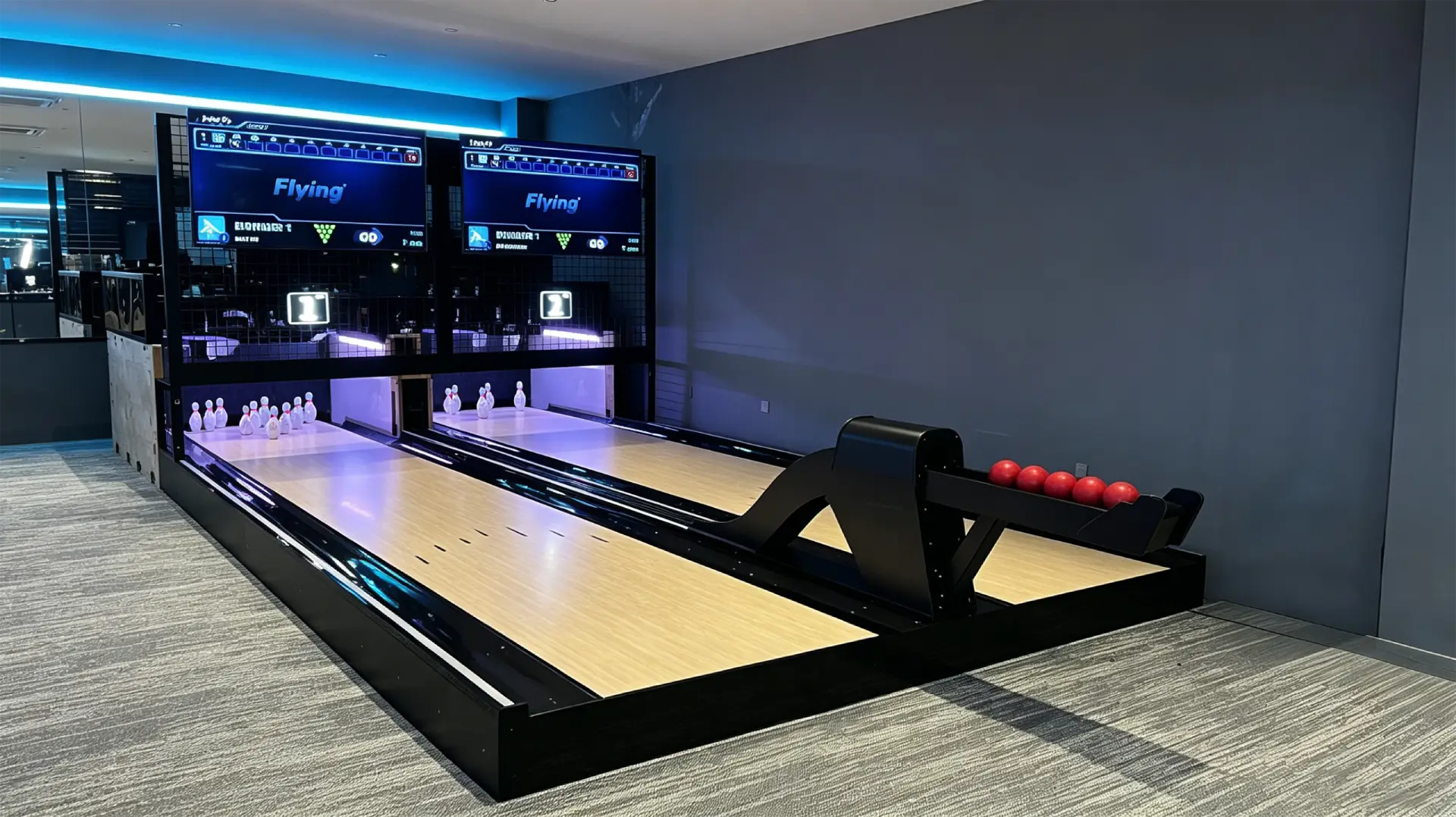
Flying Smart Duckpin Bowling Equipment for Commercial Venues
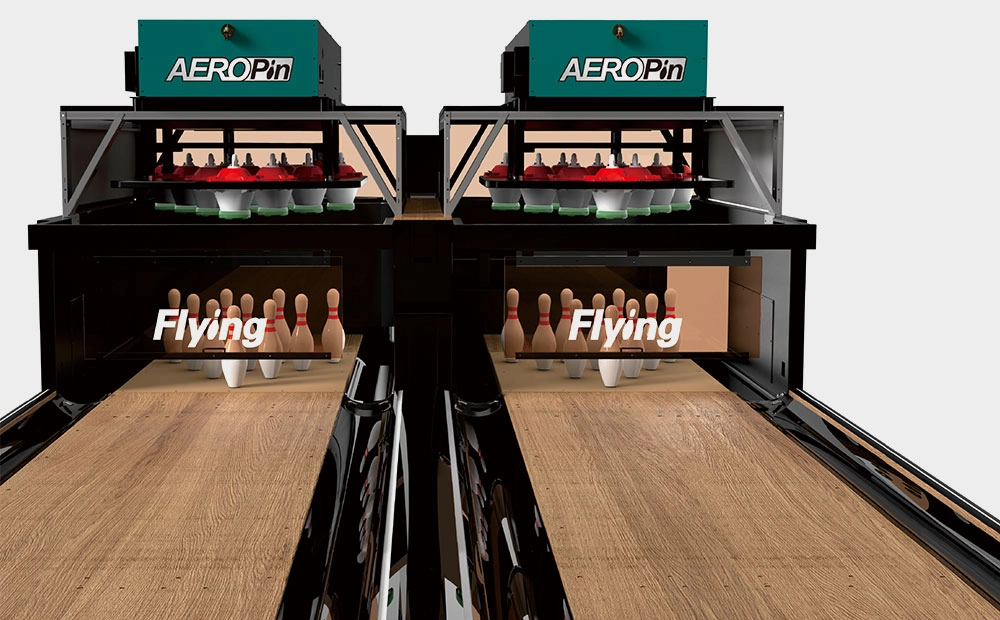
AEROPIN™ USBC-Certified String Pinsetter System
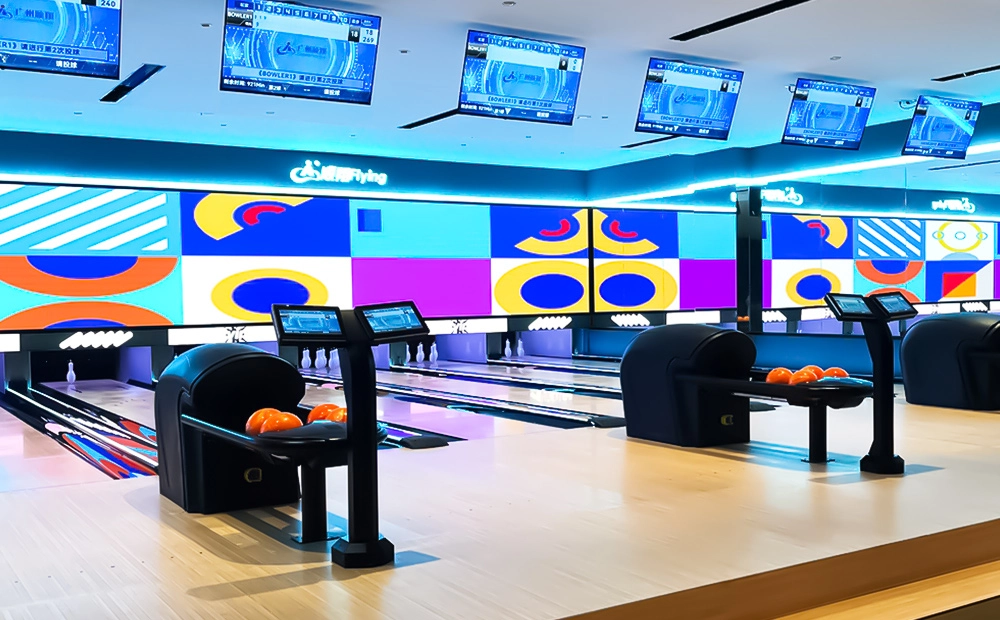
Medium Bowling Equipment for Compact Social Venues
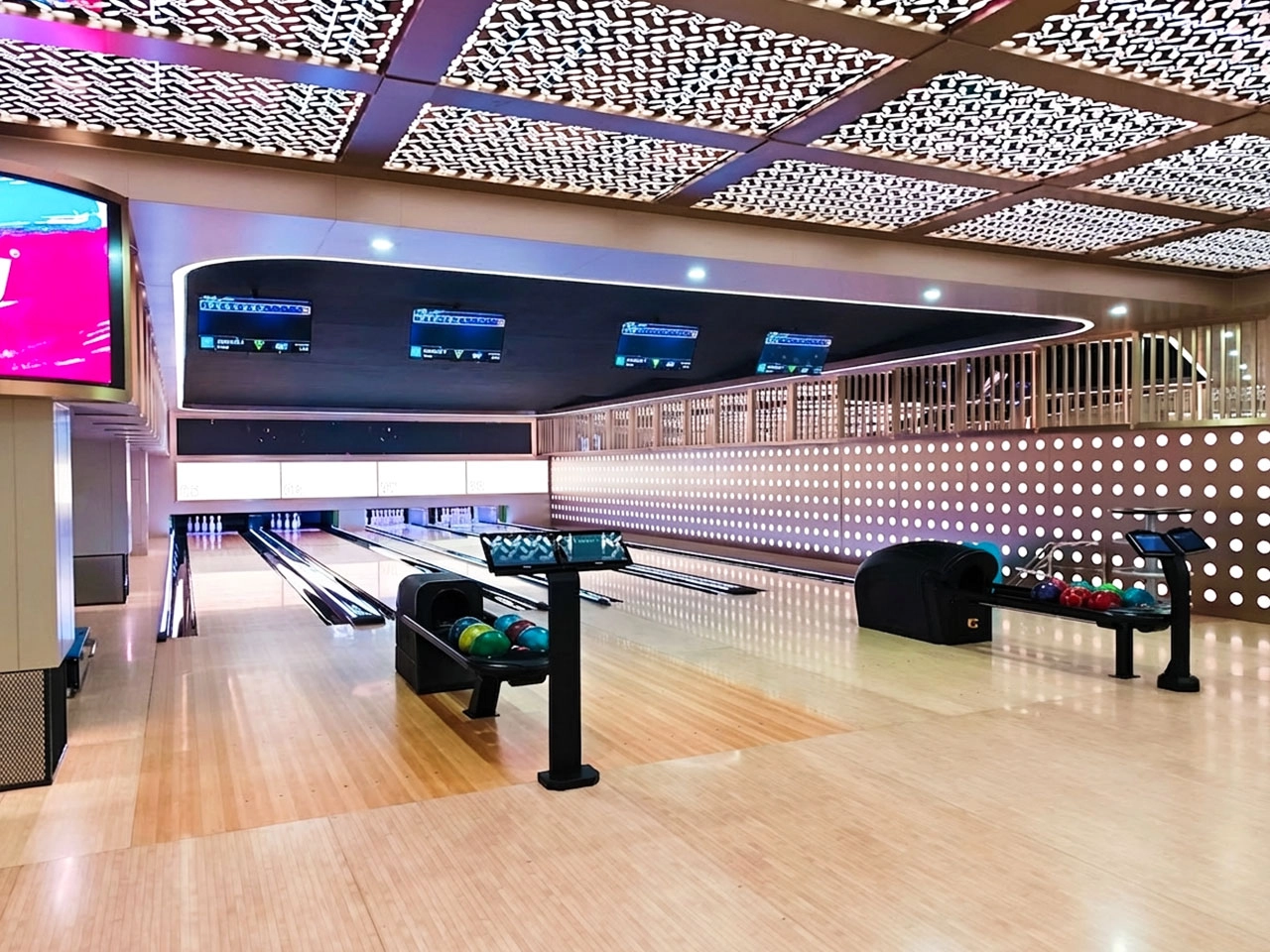
Complete Bowling Alley Equipment Package for Commercial Bowling Centers
You may also like
Build a commercial bowling venue with Flying’s complete string pinsetter bowling alley equipment package. The system includes the AEROPIN™ USBC-certified string pinsetter, customizable lanes, automatic scoring, ball return, lane lighting, pins, control hardware, and overseas installation support.
Designed for commercial bowling centers, family entertainment venues, hotels, resorts, bars, and premium private projects, this turnkey bowling system helps operators reduce sourcing complexity and prepare for reliable long-term operation.
Flying Smart Duckpin Bowling is a compact duckpin bowling equipment system designed for bars, family entertainment centers, hotels, resorts, cinemas, boutique bowling alleys, and social entertainment venues. With a standard 9.13m duckpin bowling lane, 1.25kg lightweight balls, automatic scoring, ball return, LED lighting, and a smart string pinsetter, it creates a fast-paced and easy-to-play bowling experience in a smaller footprint than traditional bowling.
The system is available as a turnkey duckpin bowling package, including lane equipment, a string pinsetter system, scoring hardware, control software, global shipping, installation guidance, and technical support.
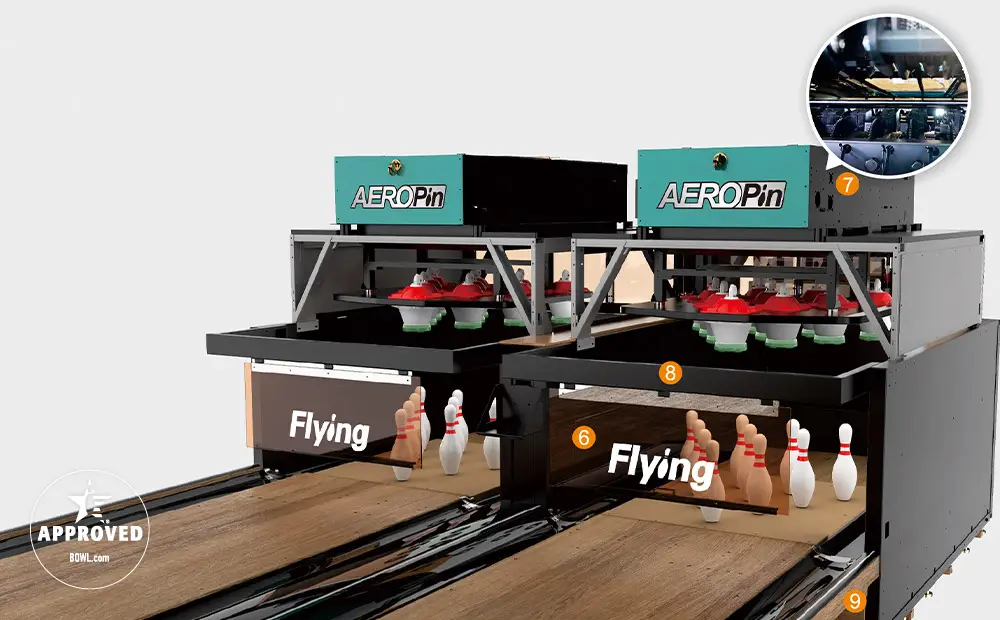
AEROPIN is Flying Bowling’s USBC-certified string pinsetter system for modern commercial bowling centers. Designed for fast pin setting, smooth ball return, low maintenance, and stable daily operation, it helps venue operators build league-ready and entertainment-focused bowling projects with confidence.
Flying Social Medium Bowling is a compact medium bowling equipment system designed for bars, cafes, family entertainment centers, community leisure venues, hotels, resorts, and small indoor entertainment spaces. With customizable lane lengths from 9.6m to 18m, small balls, lighter pins, string pinsetter technology, ball return, and automatic scoring, it creates an easy-to-play social bowling experience for players of different ages and skill levels.
Compared with full-size standard bowling, medium bowling requires less space and offers a more casual, interactive format. It is a practical choice for venues that want to add a bowling attraction without building a full commercial bowling alley.
Contact Flying
Start your bowling alley project
If you contact us now for more details, we can provide you with a custom bowling alley service. Our service team will get back to you within 24 hours normally!
© 2026 Flying BOWLING. Designed by gooeyun.
FOLLOW US:
Flying Bowling
Flying Bowling
Flyingbowling
Flyingbowling